Key to the Sacred Pattern

05 April 2007

Thoughts on the Grail at the Last Supper

With Easter coming up, I thought it might be beneficial to look into the most persistent of all theories of the Holy Grail. The most common theory is that the Grail is the cup Jesus used at the Last Supper. Given that Biblical accounts of the Last Supper describe historical events, Jesus did use some sort of vessel to drink from. Therefore, this cup or cups did at one time exist.

The implication here is something that is not talked about in modern day Grail studies. Today the Grail means something different to different people. The Cup of Jesus, Jesus’ blood line, the Ark of the Covenant, a Druidic Artifact, and The Philosopher’s Stone top the list. Differing interpretations of the Grail’s nature have existed since the time of the first Grail romances. The trouble is that groups would attach their own meaning to what the Grail was and muddy the waters for the modern day Seeker. Because of the antiquity of Grail legends, there could be some validity to each theory.

For example, in the early 1600’s the Rosicrucians have a stone they believe to be the Philosopher’s Stone. They attach the moniker of Holy Grail to it, and base an esoteric system around the Stone being the Grail. The metaphors the Rosicrucians use for the Grail are the same Grail Romance metaphors used by the Priory of Sion to describe the Grail as the blood line of Jesus. Both views are that of the Holy Grail, but of two different Grails. Looking at Grail studies in this light now aren’t popular because everyone wants to have a definitive answer as to what and where the Grail is. You can’t sell books telling your theory or show up on a History Channel special if you view Grail studies with this type of diversity.

In order to limit the scope of the discussion, I have stuck to a Socratic method of looking at a primarily Christian tradition. Please don’t e-mail me and shout that my views are limited and I’m not being opened minded. The attempt here is to look at one facet of this Grail theory. This article is also part of my “diversification” of Grail mysteries. There might be more that one cup used at the Last Supper, which explains why there are a host of Grail Cups out there. With that out of the way, let’s begin.

Would anyone have thought to venerate that particular cup?

According the Matthew, Jesus did predict his crucifixion (Matthew 26:2) and say that he would drink with them from that cup until the “Kingdom of God will come”(Luke 22:17-18). That’s a point in the Apostle’s favor in viewing the cup as a potentially sacred object worth holding on to. However, the Apostles weren’t always so attentive to Jesus’ teachings. The Apostles fell asleep when Jesus told them not to, they didn’t understand parables, and they tried to casting out demons when Jesus told them not to. The Apostle’s list of follies goes on and on. So, would one of them have the presence of mind to preserve the cup? At the time of the Crucifixion, I’m not so sure.

Two days later when your Rabbi is said to have risen from the dead, that’s a different story. I would like to think that I would be saving items that were linked to someone that had just walked out of his tomb. Given a tradition of Holy Jewish objects, it’s plausible that at least one of the Apostles would have thought the cup used at the Last Supper would have had been at very least a sacred object.

Could there be multiple Grail Cups?

The Haggadah (translated from Hebrew as “telling”) is a text that describes Passover ceremony and etiquette that has been around since at least 200 AD. Some scholars believe the traditions and some of the Haggadah texts go back to the time of the Second Temple Period (560 BC to 70 AD). The text describes using four different cups to perform the Passover ritual. Each of the cups is used to symbolically express the redemption and exodus from Egypt and Israel’s birth as a nation. (Exodus 6:6-7) Were all Passover rituals done the same in the first century? No, just as not all Passover ritual is exactly the same today. They vary from family to family and Jewish Sect to Jewish Sect.

The Gospels refer to “the cup” in Matthew 26:27. This is the Greek word , and according to Strong’s Concordance it is a singular noun. Then again, this refers to the cup that Jesus used to establish the New Covenant. In that sense there was only the one cup that was used for that activity.

Why would the Cup used at the Last Supper have miraculous powers?

Mark 6:56 tells of the sick and infirm being laid on the roadside just for the chance to touch Jesus’ garment to be healed. The text goes on to say that those who did touch Jesus were healed. Given your views on the divinity of Jesus, there are a couple of routes to go on this point.

    1. The cup used for the first sacrament transubstantiated the wine in the cup to Jesus’ blood. Thus imbuing the cup with Jesus’ powers.
    2. If that cup was used at the Crucifixion to catch Jesus’ blood by Joseph of Arimathea, then the same holds true as above
    3. The Cup has no powers what so ever and by faith alone its miraculous powers are seen
    4. The Cup has no powers and it’s all a fairy tale.

Could the cup have survived to present day?

Sure why not? If I can go on E-Bay and find a cup that dates from 2500 BC that was found in the Indus River valley, then it is very possible. Besides that, for whoever was the steward of that cup, it was a sacred relic. Holy objects generally aren’t put in a chest and forgotten about. Unless of course the person that put that item in the chest never tells anyone what the significance of that cup. Thinking they will pass the cup on to someone on their death bed, fate snatches them before the secret can be told.

Could the Grail, as a cup, have a longer history than the Last Supper?

There is a tradition in the Languedoc region of France, that states the Grail cup has a much longer history that the Last Supper. This tradition states that Adam was the craftsman of a wooden Grail. Supposedly the wooden cup was the only legacy Adam left his descendants. Adam’s cup was passed down the Davidic line and eventually inherited by Jesus. What better cup to use at the Last Supper than one crafted by the first man? This legend has the added bonus of sounding like the Nanteos Cup.

So if the Grail is the Cup Jesus used at the Last Supper, what happened to it?
This is the fun part. If there were multiple cups used tat the Last Supper, then might this explain the multiple Grail Cups that can be found today? A number of these contenders for the title of “Holy Grail” all have very similar characteristics. The Valencia Chalice, The Marian (or Hawkstone Park) Cup, Chalice of the Abbot Suger of Saint-Denis, The Sacro Catino, and Rocco Zingaro's Cup have laid claim to be the Grail and have some physical similarities. Maybe all, some, or none of these cups were present at the Last Supper and their legends grew from simply being there.

What’s the Point?

The point to all of this is not to pin-point what the Grail is or if the Grail is the cup used at the Last Supper. I hope I’ve demonstrated that there is a general fallacy in the way most of us think about the Grail being one particular object or idea. For most of us who look for the Grail through research, I think it’s a lesson well learned. One can spend copious amounts of time going down blind alleys if one tries to mismatch their research with their personal vision of the Grail.


01 April 2007

A Visit with the Shepherds at Arcadia

Early this week, I took Laura and my 6 year old son, Robert, to Atlanta for little man’s first official “vacation”. Our agenda was nothing other than to play tourist and visit some family. I was in the hotel lobby perusing the gaggle of poorly designed flyers, when the words “Louvre Atlanta” caught my eye. I then had a moment of serendipity when I realized this exhibit’s star offering was Poussin’s Les Bergers d’Arcadie (Shepherds at Arcadia). I hate to rat myself out, but I had no idea that the painting was a short 4 hours from my home.

What fascinates me is that the painting has become a modern-day Grail artifact. The mystique that has grown up around this painting has sucked me in as much as the possibility that there are hints about the Grail hidden in plain sight. Being the good Grail Seeker, I had to see the painting for myself, and review what I knew of its history.

I will not take your time and retell what has already been written about the painting or Poussin. Concise histories and fun facts of both can be found at the following site links: Wikipedia, Art Cyclopedia, and New Advent.

The painting took to the underground stream in 1982 with the publishing of Holy Blood, Holy Grail . The book put forth the theory that Poussin was involved with the Prior of Zion and painted Shepherds as a hint to the Priory’s secret knowledge. The authors point out that Shepherds bears an inscription on the tomb that reads “Et in Arcadia Ego”. The authors make a claim that this is an anagram and also point out it was family motto of Pierre Plantard. Another claim was made by Richard Andrews and Paul Schellenberger in their book, the Tomb of God. These gentlemen claimed that the painting was an actual scene around Rennes-le-Château, and geometric relationships in the painting formed a sort of treasure map.

In the last few years, the painting itself has not been in the news. However, there a mirror image sculpture of Shepherds at Shugborough Hall in Staffordshire, England that has. This sculpture has the inscription of :

    O•U•O•S•V•A•V•V
D•                   M•

The meaning of this inscription has never fully been understood. In 2004, Bletchley Park set an open contest to make sense of the inscription. On 25 Nov 04, the Bletchley Park web site announced the code was: Jesus (As Deity) Defy. The BBC website reported on the announcement here. The article also promised that in the near future many of the methods and solutions would be made public on their site. That has never happened and there is nothing that I can find, on the Bletchley Park web site that refers to Shugborough Hall. I even tried to contact an official at Bletchley in early 2006 for an explanation. My e-mail was never responded to. Sadly enough, the attention to the sculpture had an unintended consequence. On 14 May 04, the BBC reported that vandals smashed ornamental shells at the top of the monument.

Shepherds is being shown at the High Museum of Art as part of a loan from the Louvre until 2 Sept 07. Overall the Louvre Atlanta exhibit had a number of great pieces. I wasn’t impressed with the size or presentation of the works shown at the High. There was no attempt by the staff to connect the pieces to either history or a shared human experience. So if you’re headed to Atlanta thinking you’re going to get the Louvre in miniature, you’ll be disappointed.

However, one thing the High did get right was security. Art theft is a much more prevalent crime than most people realize. So much so the FBI actually has a full time art theft unit. I made the nice security guards quite nervous by viewing the painting much longer than the average tourist. No one has ever told me that I fit the profile of an art thief. (Maybe it’s my striking resemblance to Pierce Brosnan) With this type of security in mind, leave your cameras in the car. There is no photography of any kind in the Louvre exhibit.

I did leave the exhibit with a couple of observations about the painting itself. The first thing that struck me about the Shepherds is a matter of color. The pictures you’ve seen on line and in art books doesn’t quite get the color right. The colors are much more subdued that one would be lead to believe by photographic representations. The other thing that stuck out was the brush strokes. In the upper right hand corner of the painting the brush strokes are more prevalent than in any other place in the painting. I’d lay better odds that there is something “hidden” in the brush strokes than in the geometric layout of the painting’s elements. It would be rather easy to embed a short string of letters or numbers in a dark blue field using simple brush strokes. Then again, I tend to be simple in my musings…

If you find yourself in Atlanta, by all means put the High on your list of places to see. Even with all the petty whining I’ve done, Shepherds at Arcadia is something to behold. The work is a piece of modern day Grail history, and to see it felt like a small victory to this Grail Seeker.


Digg!

29 March 2007

Grail Seekers Media Watch for late Febuary and most of March..

News from Grail Seekers:
I would get to write more if life in general didn’t get in my way. If you’ve just won the lottery and would like to be a modern day Medici and be my patron, let me know. And without further ado, there’s a lot to catch up on.

On Audio:
Whitley Strieber interviews Laurence Gardner on the Lost Tomb of Jesus.

On the Web:
Walt Disney and his role in the De Molay Society.

A press release about the new Key Insight website that might interest many of you out there.

Planning on going to Paris in October for the 700th anniversary of Black Friday? If you’re there, you might want to check out this seminar/tour.

Thoth Web gives an overview of the Druids.

A brief history of the city of Petra, without Indy finding the Grail there by the way.

The validity of the Pumaz Report is put to the test by Society Perillos.

Esolibris has a nice article on the use of the skull and crossbones as a Templar symbol.


In the News:
Explore the heresy of Manichaeism that influenced the Cathars.

Journalist Priscilla Greear takes to the pilgrim path in the Holy Lands Sites.

Baignet and Leigh get an unfavorable ruling by the British Court of Appeals. If you’re looking for a full copy of the ruling, click here.

More conspiracy theories abound around the Bard of Avon. I just thought that Shakespeare wove code into his works.

Want a Templar credit card?

More information of Templar tunnels in England, this time in Leeds.

I’m not going to try to list all the articles on James Cameron’s Jesus Tomb documentary. So here’s the Google search page so you can browse for yourself.

Is the term “Holy Grail” used as a metaphor too often?

Repairs and restoration work continues on Rosslyn.

In Print:
Philip Gardiner’s new book The Ark, The Shroud and Mary takes a new look into Biblical artifacts.

Here’s an excerpt from Graham Simmans’ new book Jesus after the Crucifixion: From Jerusalem to Rennes-le-Château.

Tips and Site of the Week:
New friend of Grail Seekers this period is blogger Pridian and his site: Codex Celtica: Exploring The Mysteries Behind The DaVinci Code. Check his blog out and get a British perspective on some of the Grail mysteries.

Also if you're interested in Freemasonry and the Scottish Rite, I know many Valleys will be preforming Maudy Thursday and Easter Sunday rituals next week. In Nashville, this ceremony will be open to the public. Check with your local Grand Lodge to see if these are open to the public. It's a rare chance to see what a Scottish Rite Degree is like, plus its an interesting service.

17 February 2007

Grail Seeker Media Watch for the Weeks Ending 10 and 17 Feb 07

Upcoming on Grail Seekers:

Well I would never make it in the newspaper business simply because I can’t meet a writing deadline to save my soul. I’m still trying to bang out a few past promised articles, so please bear with me. Life and work has a way of screwing these things up when this is your “hobby”.

On Audio:

19 Feb 07 on Coast to Coast AM; director of the New World Discovery Institute, Gunnar Thompson, will discuss the forbidden history of the world before Columbus.

On the Web:

The Bloodlines movie web site has an update on supposed Priory of Zion artifacts.

Author Philip Gardiner pens an article on the state of things in the Book of Thoth.

Is the number 22 the key in the Rennes-le-Château mystery? Andrew Gough seems to think it might.

The Daily Grail gets a facelift. Thanks guys, the site is much easier on the eye.

Leyzzy’s blog has some thoughts on symbols at Rosslyn.

In Print:

The Desecrated Abbey, a new book available only in Spanish, claims that Himmler went to Spain looking for the Grail.

Yet another Templar novel deals with the Cross of Ramplet

In the News:

1.8 million Indian manuscripts are now available on line. This might be valuable for all those looking in to Jesus or the Apostles in India.

More post Da Vinci Code fall out, the Louvre staff goes on strike due to stress. They should try working my job…

More questions arise over the James Ossuary in Israel.

New medieval views of Stonehenge arise

The city of Royston gets on the Hertfordshire Templar/Grail tourism train.

More artifacts are found at the Temple Mount. If you haven’t been following this story over the last few years, any excavations there have been a hot mess.

Did Jesus build a hut in England?

In Film:

The Number 23 is sure to spark more conspiracy theories in the next few weeks. Like we needed more of those.

Game on:

Knights of the Temple 2 is due to ship this week. I’m not sure if it will be available on the US. The first Knights of the Temple was not and the Xbox version was only in PAL format. And good luck trying to find a PC version on Ebay.

The Crossing comes to Xbox 360. This game takes you into a world where the Templars survived Black Friday. Funny, I thought they did.

Tip of the Week:

For the last couple of years I’ve been using Microsoft One Note to compile articles related to the Grail and other areas of interest. Imagine an electronic card file that you can seamlessly copy articles, video, and art from a web page. It makes doing research so much easier since articles that appear on the web have a habit of not staying around too long. It’s also integrated with all of Microsoft programs, which is a plus. The new 2007 version should be available later this month.

04 February 2007

Grail Seekers Media Watch for the Week Ending 3 Feb 07

Upcoming this week on Grail Seekers:

Ok mid-week has turned into late week with issues at work and home baring my finishing the George Smart interview. It will be done by days end. I’m off all day and there’s snow on the ground in Nashville. I have a pot of coffee on and nothing else to do.

On Audio:

The Laura Lee show has a pod cast of Ann Masai speaking on Decoding the Black Madonna

On TV:

Who Wrote the Bible; History Channel; 4 Feb 07; 7:00 CST: What are the origins of the Bible? Who actually wrote it? We'll explore possible answers with visits to Egypt, the Galilee, the Israel Museum in Jerusalem, and the caves of Qumran, where the Dead Sea Scrolls were discovered.

In the Flesh:

William Henry will be making the tour circuit in the next few months. On 20-21 Apr 07 He will be in my home town of Nashville. William if you’re looking of a Grail Seeker’s perspective on the conference let me know.

For those interested in the Glastonbury Grail Conference that I mentioned last week, here’s the official press release with contact info.

In the News:

This week there seems to be more Grail tangents in the news than anything of note.

Researches are on the trail of Da Vinci’s lost masterpiece "The Battle of Anghiari"

Archeologists find an ancient village near Stonehenge that might have housed the folks that built the monument. Also, it looks like there was a temple near Stonehenge as well.

A messianic Shiite cult springs up in Iraq

The cave where Romulas and Uncle Remus was nursed by a wolf is found in Rome.

Tip Site of the Week:

Online Medieval and Classical Library

The University of Berkley has electronically collected a number of key medieval texts. Searches can be conducted by title, author, genre or language. Most of the texts are downloadable and are public domain. Key works listed are: Arthurian legends by Chrétien de Troyes, miscellaneous Chaucer works, The High History of the Graal, The Nibelungenlied and Codex Junius 11.

30 January 2007

Thanks for the Link

I would like to thank the fine folks at the Rennes-Le-Chateau Research and Resource web site for placing a link to the Grail Seekers blog on their page. If you have interest in the Rennes mysteries, you will want to check out their web site. Other than an exhaustive amount of information, the artwork and links pages are worth the visit alone. Thanks again to this new found friend of Grail Seekers.

28 January 2007

Grail Seekers Media Watch for the Week ending 27 Jan 07

Upcoming this week on Grail Seekers:

Friday I got the chance to interview George Smart , the author of The Knights Templar Chronology: Tracking History's Most Intriguing Monks . I’m putting the finishing touches on the article and should have it ready by mid week.

On TV:

For all of you who have feeds into BBC 4 or live in the UK; the show The Search will highlight some Grail related sites this season.

On the Web:

A nice picture of the January Blue Apples in Rennes-le-Chateau

Andrew Gough has a nice piece on the 90th anniversary of Bérenger Saunière’s death.

Society Perilos continues it’s article on enigma of Bérenger Saunière

In the News:

Judgment on the Baigent and Leigh appeal to happen by Easter.

A 2nd Temple era street is found in Jerusalem.

Coming to Glastonbury this summer is the Holy Grail Conference with some of the top authors in recent Grail history. Unfortunately, it’s only open to UK residents.

Did Templars build the Newport Tower in Newport, Rhode Island?

Rosslyn Chapel makes a pile of cash post Da Vinci Code. The good news is those funds are going to restoration work.

Who was Mona Lisa? A 16th century death notice may hold the key.

The Scotsman continues it’s series on the origins of the Scots, the Stone of Destiny and the Grail. (I know this is an old article, but I can’t catch everything…)

Leonardo’s fingerprint is reconstructed. For all of you historical CSI folks that want to dust for 500 year old prints.

Ancient Semitic spell found on Egypt, this might be the oldest example of the language to date.

Tip Site of the Week:

For all of you interested in Jewish Hexagrams, check out the Star of David blog. These show up in all sorts of places that you might not expect. There’s some nice work and pics on Zeevveez’s blog. He’s also interested in the Templar use of hexagrams, if you have any information or insight on this, email me and I’ll let him know.

20 January 2007

Post Script on the Hertfordshire Mysteries

I appreciate all of the positive feedback I've gotten on the Hertfordshire Grail Mystery Reexamined piece. The predominate response I received was after Tim Acheson's well being. I am happy to say that I contacted Tim after the piece was posted and he seems to be doing just fine. He even gave a thumbs up about the article. I'm sure Tim would appreciate everyone’s concern. The world is a much more interesting place with Tim and Ben around.

BK

Grail Seeker's Media Watch for the Week Ending 20 Jan 07

On Audio:

Dreamlands had an interview on the 13th with Christopher Jones, the lad that translated Otto Rahn’s book about the Templars, Cathars, and the Catholic Church (see the In Print section below) Good thing you can catch these on a pod cast.

This one will be good. On Monday 22 Jan 07; Coast to Coast AM will have Andrew Sinclair and Mark Pinkham on talking about Rosslyn Chapel. I wouldn’t miss this one.

On TV:

The History Channel is showing the Lost Worlds: Knights Templar show and Digging for the Truth - The Da Vinci Code: Bloodlines; Sunday 21 Jan 07 starting at 7pm EST

And on Tuesday 30 Jan 07; there’s Lost Worlds: Braveheart’s Scotland at 8pm EST.

On the Web:

Farshores reprints an article on 25 Dec 06 about some different theories about Oak Island from the First National News.

Why the Southern Poverty Law Center would have an article on conspiracies and the Catholic Church is beyond me. But, it is a good article..

In the News:

Michael Baigent and Richard Leigh take another stab at their lawsuit against Dan Brown in the English court system.

The Shiners come under fire from OpedNews.com for misuse of their tax exempt status. I wish when people do pieces like this they would name specifics instead of listing general charges. Read critically.

The Baltimore Sun has a profile on Brent Morris the author of The Complete Idiot's Guide to Freemasonry

Since the theme this week seems to be Freemasonry, the British Telegraph takes a look at what the real secret is of Masonry.

Out of the copious good-byes to Robert Anton Wilson, I think I enjoyed this one the most.

While not directly related to the Grail, Napoleon’s death has been ruled stomach cancer rather than poisoning. This puts to rest some historical conspiracy theories about the little man’s death.

In Print:

I’m a little slow on this one, but if you haven’t heard in October Otto Rahn’s work Crusade Against the Grail has been translated into English. This one is for those of you looking for information about the Nazis and the Grail.

Tip Site of the Week:

Microsoft Live Maps Not to be one upped by Google, Bill Gates has put Microsoft’s spin on a bird’s eye view of the world. There are very few differences between this mapping system and Google Earth. The interfaces are similar and I can’t tell too much difference in the 3D map features. The Microsoft version does seem to bookmark places a little easier than Google Earth. Oh well, it’s an alternative if Google Earth’s servers are down.

17 January 2007

Hertfordshire Grail Mystery Reexamined

2004 passed with many of you not knowing the names of Tim and Ben Acheson. This is not surprising to my American audience since the story was chronicled in newspapers, magazines, and a TV special in the United Kingdom. For our UK Grail Seekers, you might recall that the Achesons made a splash in the underground steam with an announcement to a reporter from the Hertfordshire Mercury. The Acheson brothers asserted that there are tunnels under Hertford, a small town 20 miles north of London, which are still in use.

What’s so surprising about that? If I were to tell you that the tunnels were used by modern-day Templars and members of the Illuminati, what would you think? What if there was an immense treasure that might be the Holy Grail, under Hertfordshire? Those are the questions the world had to answer after Raymond Brown’s article about the Acheson brothers appeared in the 8 October 2004 issue of the Hertfordshire Mercury.

If you’re not familiar with the Achesons, I’ve listed links to all the relevant articles at the bottom of the page. I would highly recommend reading these articles.

The Acheson’s story is that they are descendants of a Templars family. While they will not confirm their role within any modern-day Templar organization, they seem to know quite a bit about the group’s goals. Tim Acheson was interviewed by the Guardian in January of 2005 and gives some hints about the importance of Hertfordshire and the Grail mystery. Tim claims that groups of Templars came to Hertfordshire after Black Friday in 1307 and made it a base of operations. He believes that the passages below ground in Hertfordshire may hold the answer to many of the questions about the Grail and the Templars.

Acheson even took a couple of reporters on tours of these underground passages. According to Acheson the whole city is honeycombed with tunnels that are used by the Templars and the Illuminati as a meeting site. Through out the articles on Acheson, he is rather hidden about what he knows, or suspects, is going on in Hertfordshire. He makes references to revelations that could be forth coming due to a new generation of Templars wanting to be more open. If one takes a closer look at the facts presented in the press; a few interesting possibilities open up.

In May of 2005, the Hertfordshire Mercury reported that a Vernon Gifkins was identified as one of the first people to enter Hitler’s bunker in May of 1945. Tim Acheson was also identified and quoted as being Gifkins' grandson. We come to find out that Gifkins was also an MI5 agent and according to Tim, “"He was a real character, hunting man-eating lions in Africa and also a lot of real James Bond work. He took some very interesting documents from the bunker." Given Hitler’s penchant for the occult, one wonders what might have been taken from that bunker.

One has to dig a little to see what the relevance of Gifkins is to the claims the Achesons have made. The article mentions that the Gifkins “live in Bayley Hall, which his family owned, and the Old Vicarage in Church Street.” If we go back to the first article about the Achesons, there is a picture of a map that shows a1898 map of Bayley Hall. The map marks a subterranean passageway on the property that would link up with the other passages the Achesons claimed to be running under Hertfordshire. One can imagine the Achesons as teenagers exploring the tunnel systems against the warnings of their grandfather.

Tim’s interest in the tunnel system and the Hertfordshire treasure might not be a passive one. In March of 2005, the Hertfordshire Templars requested to undergo excavations on an undisclosed property in the town. The property in question is said to have been a Templar holding in 1253. The landowner denied the group’s requests. Tim is quoted as saying, “If the whereabouts of these items is still known after all this time, and they are still wanted, one can only conclude that they must have some intrinsic value.” The timing of the request leads one to believe that the Templar might be looking for hard evidence to present to the world.

I tend to think that this property is on the Brickendonbury estate in the village of Brickendon, which lies a few miles south of Hertfordshire. The estate was once owned by Sir Thomas Clarke, who built the present manor house there in the 1690’s. Clarke was also responsible for building Bayley Hall. The March 2005 article mentions that “items claimed to be "secreted beneath the surrounding fields, outbuildings, moat and house have been there for 700 years.” This loosely fits with the description of Brickendonbury.

The possible Grail and Acheson connections don’t end there. Located in Brickendon is the Chapel of the Holy Cross and St Alban, which was the chapel Brickendonbury estate. On the grounds of the chapel are a number of different types of trees. One of which is reported to be part of the Glastonbury Thorn. Also, during World War II, the Brickendonbury house was used by British intelligence to train agents in industrial sabotage. Perhaps Vernon Gifkins received some training there. It would fit with what we know of Gifkins.

Of course all of this is pure conjecture on my part. In hoping to satisfy my own theories, I tried to track Tim Acheson down. Through some sleuth work and good luck I was able to do so. We traded correspondence through October and November. Tim even agreed to do the interview with me. After sending him a list of questions, poof, he was gone. I have not heard from Tim since. Also, know that I will not disclose my method of contact with Tim. So please don’t waste your time emailing me asking for the particulars.

I do hope everything is well with him. No matter what you think of the validity of Acheson’s claims, he does live in a shadowy world. Since the Grail world is filled with those who run the gambit between reality and pure fiction, the possibilities of their actions are equally as broad. I wish Tim and Ben all the luck in the world, and more over I hope they’re on to something.

The major articles that recount the story of the Achesons can be found in the following places. Note: some of the articles are reprinted in other forums, after their links have become dead at the original source. I copied the articles from their respective original sources and can vouch that I have seen no evidence of rewrites. One can never be too careful with info on the web. Any quotes that I have made in this piece can be directly attributed to the following sources.

Secret tunnels used by Knights Templar and Illuminati in Hertford

Hertford, home of the Holy Grail
Pope was investigating Knights Templar before his election
Hertford Grail trail hits Aussie headlines
Michael Jackson checks in with tribute to historic Hertford Templar
Landowner Blocks Hunt for Templar Treasure
Revealed: Hertford's man in Hitler's bunker


Digg!

11 January 2007

Grail Seeker's Media Watch since November

After the holidays and a nasty bout of stomach flu have taken their toll on me, here’s a recap of Grail related material that’s shown up in the media for late November through present.

On Audio:

The Laura Lee show has an audio interview with Timothy Freke & Peter Gandy on Christianity’s Gnostic Origins.

Some recent interviews on Whitley Strieber’s Dreamlands you might find interesting:

Laurence Gardner on White Powder Gold

William Mann on Templar Secrets

Gregg Braden discusses his book the God Code

On the Big Screen:

Salvation, a Templar-ish movie, is slated to have a trailer shown at the Sundance film festival this year.

On the Web:

The Fortean Times has an article on discyphering Rosslyn Chapel’s enigmatic images.

The Behind the Da Vinci Code web site has links to a nice Rosslyn picture gallery and a Da Vinci Code tour of the Louve.

Andrew Gough’s blog Arcadia has an interview with Rennes-le-Château researcher Jean-Luc Robin.

Tracy Twyman investigates Sauniere’s secret room in this blog entry.

In the News:

All of you with an interest in alchemy will be interested to know that scientists have molecular rings in shape of King Solomon's Knot.

The Mayor of Hertford tries to decide on how to cash in on the Grail/Templar buzz about town. Also in other Hertford news, the Office of Tourism snubs a BBC podcast about the town and its connections.

A 500 candle ceremony lights the way to the winter solstice from a pseudo-Templar group in Snohomish County.

More talk of Masonic/Templar rock formations out in the Western US.

Saint Paul’s tomb is found under the altar of a Roman Church? You be the judge.

Archeologists find a church that was used to house the Ark of the Covenant? Once again, judge for yourself.

The Independent takes another look at Richard Leigh and Michael Baigent in a profile piece.


In Print:

Is Joseph Smith part of the blood line of Jesus? The author of the new book; Dynasty of the Holy Grail: Mormonism's Sacred Bloodline seems to think so.

Interested in winning 1 Million Pounds? (That’s UK currency, not a million pounds of pocket lint) Maranatha Et in Arcadia Ego: The Holy Grail And Da Vinci Secrets Revealed is a “solve the code and win the prize” book that was published last month. I’ve just ordered mine from Amazon, and will have some more in the coming weeks.
Extraordinary People is yet another in the recent long line of Da Vinci Code coat tail riders.

Tip Site of the Week:

Searchable database of Parzival,

If you know Middle High German, Titus has supplied a line by line searchable database for you. This site is for the hard core that are looking for occurrences of particular words within the text.

15 November 2006

Grail Seekers Media Watch for the Week Ending 11 Nov 06

On Audio:

On the Laura Lee Show on Monday 14 Nov 06; Carl Munck - Decoding the Ancient Sites

Did some ancient societies have an elaborate system of measuring and mapping an early Earth grid, and encode data into the design of temples? You decide if Munck is onto something with his theories on "archeocryptography". Could be useful to enhancing advancing some theories of church placement as well.

On the Web:

Not of Grail news, but a pretty good deal for those of you trying to trace down your UK roots, Ansestry UK has free searchable immigration records from the UK to the US from 1820 to 1960 until 30 Nov 06

On TV:

For all your Crusade studies, History Channel looks at sex in the Middle Ages Saturday, 18 Nov 06 at 10:00pm CST.

In the News:

A week late, but the Scotsman has a very detailed article about the Apprentice Pillar at Rosslyn Chapel.

Tip Site of the Week:

The Alchemy Web Site

A one stop web site for all things relating to Alchemy. There is a lengthy listing of texts, a searchable database of alchemical emblems, discussion groups, and articles to be found here.

07 November 2006

Grail Seekers Media Watch for the Week Ending 4 Nov 06

Sorry I’m a couple days late on this week’s Media Watch. A big promotion at work will throw your writing schedule in the dumper. Remember if you have any news stories, pod casts of interest, or other information for the Media Watch, e-mail me so I can share them with everyone else.

On the Web:

A Different Perspective blog has some commentary on “out of place artifacts” and the Freemasonry’s Tubal Cain. The only thought I have with his theory is that Tubal Cain also a Biblical figure, and people have been named after those. Remember Occam’s Razor folks.

In the News:

Artifacts from the First Temple period were removed this week from the Temple Mount. For those of you that have been following any news from Jerusalem and Temple Mount discoveries, I’m surprised they have found anything with all the looting that has been going on in recent years.

Researchers now think Da Vinci might have been of Arabic descent.

At the Movies:

Amazon has a pre-order deal for The Da Vinci Code, which will be released on 14 Nov 06. If you’re going to get it, you might as well get it cheap.

Evidently everyone is using the Knights Templar as some kind of plot hook these days. Gregory Read is producing Like Minds that is about two psychopathic high school boys that go on a killing spree thinking they are Templars… Nice.

National Treasure 2 is listed on IMDB as being in production. The plot evidently is relating to the Lincoln Assassination.

Tip Site of the Week:

The Blue Letter Bible

Looking for a Biblical quotation? Not sure what some passage means? What to know where Tubal Cain was in the Bible? The days of trying to figure out what the abbreviations in Strong's Concordance and thumbing through pages of text are over. The Blue Letter Bible provides a powerful search for references in the Good Book. There are also on line commentaries, maps, images, and study tools available. A valuable on line resource for tracking down and understanding your Biblical leads.

29 October 2006

Grail Seekers Media Watch for the Week Ending 28 Oct 06

On Audio:

  • This week Dreamlands interviewed Graham Hancock on his new book Supernatural. Even though this has zero to do with the Grail, many of us became Hancock fans after reading Sign and the Seal. After clicking on the link Dreamlands above, hit the listen now link at the upper right hand corner of the page to listen to the interview.

On the Web:

  • Philip Coppens posts an article on his web site that explores the Neapolitan Chapel of Sansevero for all of you who are looking into clues in the symbolism of churches and cathedrals.
  • Of general note, The History Channel has a number of Podcasts that you might want to check out. The page has an items segregated by topics and has a search engine.

In the News:

  • The mystery of Rosslyn Chapel deepens a little as a light box is “rediscovered” in the Chapel that only is seen on 21 Sept or St. Matthew’s Day. The Scotsman reported on this on 27 Oct 06.

Tip Site of the Week:

  • Not being a Catholic, I am not well versused in the patronage, feast days, or back stories of the over 5000 Saints. There are times that the Grail Seeker might need to check out a Saint or two. If you’re in the same boat, check out the Catholic Forum’s Patron Saint Index. This is a searchable database with over 7000 entries that will help cut to the chase when doing research in this area.

22 October 2006

Grail Seekers Media Watch for the Week Ending 21 Oct 06

Folks, it’s been a pretty dry Grail in the media week. I’ve found one article that might be of interest to the Grail Seeker.

To make this blog at least worth reading, I’ll throw out some web sites that I’ve found this week that might be of help to you and your quest.

Grail Literature References


Searchable database of Parzival, line by line

If you know Middle High German, Titus has supplied a line by line searchable database for you. This site is for the hard core thatare looking for occurrences of particular words within the text.


Grail Stories

A list and commentary on Grail literature in the Middle Ages. This is the short course on all the major Grail works is at your finger tips.


Dictionaries and Translation Sites


Foreign Language Dictionaries

Here’s a listing of free on line dictionaries. Latin, Greek, Hebrew, English, French, and German are all listed. There’s also a handy list of biblical dictionaries. A fun dream interpretation dictionary is listed as well. Remember these are not translation sites. But they are good for getting other possible nuances of words that translation software doesn’t quite get.


Lycos has created a means break down language barriers on the Web. Their Bable Fish (a nod to all of you Hitchhiker's Guide fans) translator will translate entire URLs or text string entries. Translation software, in general, has come along way in the last few years, but does have its limitations. Idiomatic expressions, subtitles of meanings, and tense are always a sticking point in any translation program. At very least, it will give you a much clearer picture that you had looking at a foreign language screen. Languages supported for translation into English are: French, German, Portuguese, Spanish, and Italian.


Word Lingos is another free translation site that supports all the languages of the Lycos translator as well as Simplified and Traditional Chinese, Dutch, Greek, Japanese, Korean, and Russian.


Free Translation has a number of languages listed, but the special character tools listed are unique to this site. You can translate strings of text and change those pesky odd characters like vowels with umlauts in German with this version.

Thanks for the Link-Back

Another kudos goes out to The Quest for the Holy Grail blog for putting a link to Grail Seekers on their page. The Quest blog is taking the search through the Arthurian Romance texts. Check it out. Huzzah

15 October 2006

Grail Seekers Media Watch Week Ending 15 oct 06

  • History Channel has a number of specials of interest this week.

Sunday; 15 Oct 06: 6-7pm CST; Lost Worlds - Knights Templar.

Sunday; 15 Oct 06: 9-10pm CST; Strange Egypt

Monday; 16 Oct 06: 9-10pm; Lost Worlds - Atlantis

Saturday; 21 Oct 06: 6-7pm ; Modern Marvels - Da Vinci Tech.

  • On the Laura Lee Show; Wednesday 18 Oct 06 Gregg Braden talks about the wisdom to be found in ancient texts throughout the world.
  • There were a ton of Friday the 13th articles out this week here, besides mine here are just a few from my Google news search.

Friday the 13th
Belfast Telegraph - United Kingdom
... Also, recently brought to light by Dan Brown's ubiquitous The Da Vinci Code, is the role the Knights Templar may have played in enforcing the stigma attached ...

Calendar date superstitions are a numbers game
Blairsville Dispatch - PA, USA
Oct. 13, 1307. On that date, France's King Philip IV had the Knights Templar imprisoned and subjected to torture and execution

Locals profess little trepidation about Friday the 13th
EastOregonian.info (subscription) - OR,USA
"There is the theory that it became unlucky after the King of France executed the Knights Templar on Friday the 13th," said John Tillman, when asked where he ...

Happy Friday the 13th!
Cinematical - Santa Monica,CA,USA
For example, some feel the original Friday the 13th (or Black Friday) was when hundreds of Knights Templar were simultaneously arrested on Friday October 13 ...

Oooeer! It's Friday the 13th
OhmyNews International - South Korea
On that fateful Autumn day the king of France ordered the destruction of the Knights Templar. Hundreds were killed, arrested, imprisoned, and tortured. ...

Why Friday 13th is so unlucky
News Shopper - UK
that the Pope of the Roman Catholic church, in combination with the King of France, sentenced a monastic military order known as the Knights Templar to death .

  • Scholars discuss Sardinia being Atlantis in Rome this week.

article.

  • The Society Perillos site posted an article entitled the Enigma of the Rennes-le-Chateau Cemetary.

  • Other than that, there hasn’t been much activity this week. However, if you’re looking for a good movie next weekend, check out The Prestige. I had a chance to catch a press screening of it this week and reviewed it on my other, more free form blog Kannard’s Random Stuff. Enjoy.


13 October 2006

Thanks for the Link-back

Thanks goes out to Grouchoghandi for the link back to the site. Check out his informative and pretty funny site above. I try to give kudos to those that link to the blog. If you link to us, let me know. Thanks again for every one's support.

Brian

12 October 2006

A Day That is Unlucky; for Some


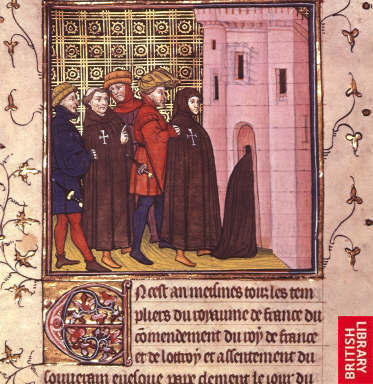
The Arrest of the Templars
from the British Library Web site

Tomorrow, in France the weather will be much the same as it was 699 years ago. A slight overcast sky and the first hints of a damp autumn chill in the wind. Tomorrow morning in 1307, a letter bearing the seal of Phillip the Fair was being opened by sheriffs. Upon penalty of death, the King’s men were not to open this document before sunrise. I’m sure this perplexed many of the simple men whose job was to maintain the rule of the King through out the country side. Many would have to have found someone to read the letter to them. Many more would not know what to make of it after they heard the contents. Phillip the Fair had ordered the arrest of all Templars in France under charges of heresy. This would have compounded the confusion of the sheriffs. The Templars involved in the black arts? The thought would have been like reading science fiction to many of the men.
An undertaking of this scope had never happened before. This was the world’s first large-scale coordinated police action. The plan was to keep the arrest order secret until the moment of the arrests. The logistics of even delivering the orders began on 9 Sept 1307. Thousands of men had to be trusted not to open the King’s orders. They would have had to be further trusted not to reveal the contents to a soul even if they had taken a peek inside.

As with most complex plans, something did not go as intended. What the leak in security was, the world will probably never know. By the time the main Templar preceptory was raided in Paris, nothing was left. The Templar fleet had vanished from the Port of Le Harve along with any documents or treasures the Order held. The number of Templars that were arrested that day is in dispute by historians. Numbers from a few hundred to 15,000 have been reported. Of whatever numbers were arrested, the one that should have escaped must have chosen not to. Jacque de Molay, the Grand Master of the Temple stayed behind and was arrested.

Now this story is not news to anyone that has studied the history of the Templars. The day has been marred since then as an unlucky day. People that know nothing of the Templars will huddle themselves in their houses, simply because they know that Friday the 13th is an unlucky day. It amazes me that the shadow of the Knights Templar reaches us even today.

The purpose of this article is not to inform, but to remind. Remind us that of the bravery of Jacque de Molay in staying behind to cover for his brothers. Remind us of the travesty of justice that occurred that day, and unless any populace is watchful could happen again. Remind us of one of the great mysteries of all time? The sometimes touted guardians of the Grail, what was taken away from their preceptory and where did they go? 

So for whatever your reasons are, just take a moment to remember. No matter what your thoughts on the nature of the Templars are, simply to remember their plight on this day is enough to keep the history alive for another year.

08 October 2006

The Return of the Grail Seeker and Article Wrap up Since August.

After a long silence, I think things have calmed down at work enough for me to resume the work of a Grail Seeker… My apologies to all that have been reading the blog. Without further ado, here’s a recap of the Grail and Grail related topics in the media for the last few weeks.

This Week’s Media

  • Monday night on Coast to Coast AM: Publisher of online travel journal, Mysterious World, Doug Elwell will discuss the Irish origins of Halloween, and provide info on fairies and leprechauns, as well as wizards, druids and cryptids.
  • Thursday 12 Oct 06 at 9:00pm EST, the History Channel will premier a special entitled The Secrets of the Dollar Bill. This special will explore the symbolism of US currency and will take a look at the US Treasury Department.


Articles and Interviews from August to Present:

  • The Guardian presented a good article on the melding of Masonic and Pagan symbolism in Nicholas Hawksmoor’s architecture. Hawksmoor was the architect of a number of Churches in London 250 years ago.
  • Physorg reports that scientists from the US Department of Energy find anomalies in silver contents of pottery during the Second Temple period. What does this mean to the Grail Seeker? I’m not sure, but it’s interesting none the less.
  • The Dead Sea Scrolls are now being tested for DNA to help piece more of the document’s fragments together.
  • Those of you that follow Carl Jung and his wife’s interest in the Grail and mystics might be interested in this article on Jung’s more mystic bent.
  • I’m guessing that the BBC read my article on Jesus in Japan and was inspired to report on it. Ok, maybe not. But if that interested you, check out their research here.
  • Robert Cooper has a new book out called the The Rossyln Hoax. (Once again avalibe only in the UK at present) I met Robert at a Masonic conference at London’s Canonbury Masonic Research Centre in 1999. He’s not only a very knowledgeable guy, but he also is the Curator of the Grand Lodge of Scotland Museum and Library in Edinburgh. A summary of the book can be found here.
  • In the realm of fiction, Johny Depp has been tapped in a film version of Dark Horse Comic’s Rex Mundi