In reading the headlines over the last year, one would think that finding the Holy Grail was as easy as picking up a shell on a shoreline. It would seem almost trendy to pick a location for the final resting place of the world’s greatest treasure. The fact is that there are more candidates for the Holy Grail out there than one could shake a rather large stick at. This is the first part of a series chronicling some of the different types and traditions of the Grail.
In this first installment of “Here a Grail, There a Grail”, we’ll focus on the Grail as some sort of vessel. This is, by far, the most predominate theory of the nature of the Grail. Most traditions link the Grail as being a vessel used at the Last Supper, although this is not always the case. The following are a description of vessels that hold to being the Grail. This will be the first part of this article. The list was just too long to present in one blog.
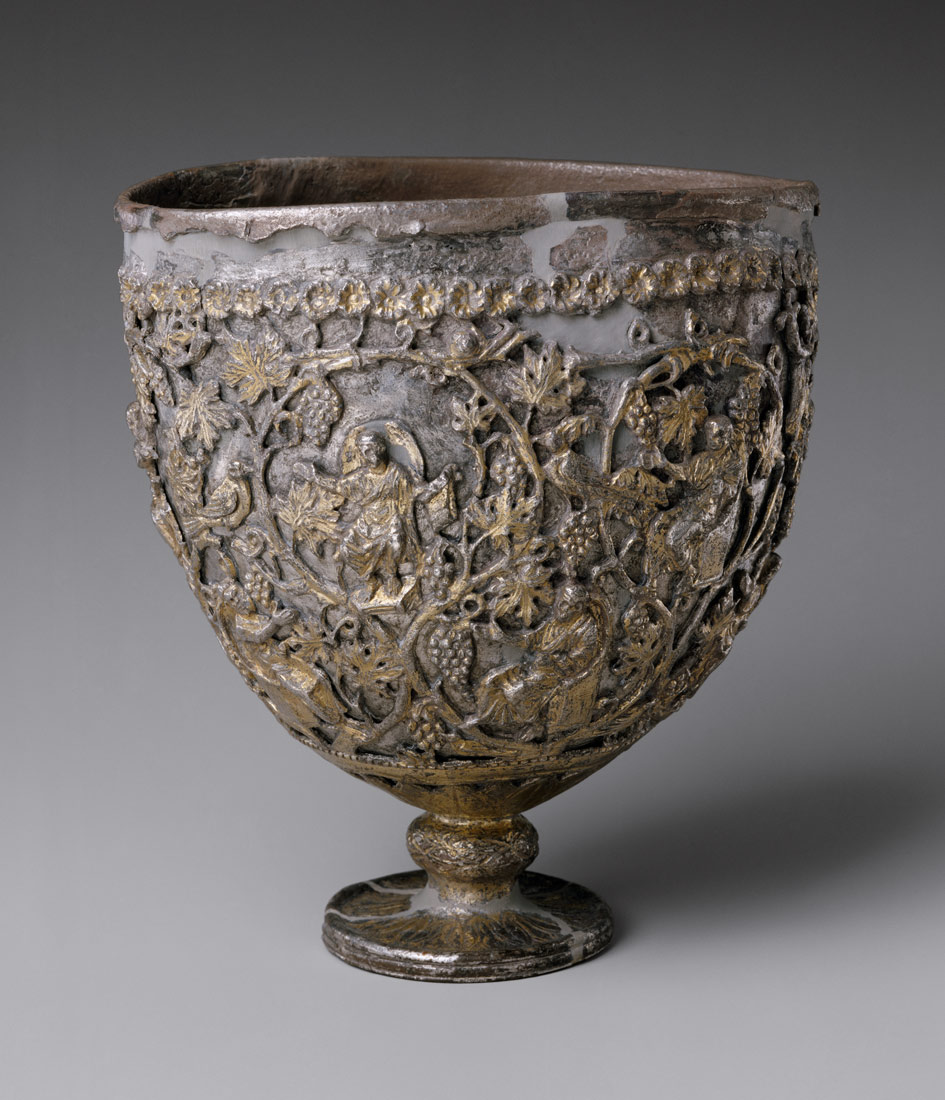
- Antioch Chalice (Image Link)
This cup was shown at the 1933 Chicago World’s Fair as being the Holy Grail. Found in Antioch in 1910, this relic is actually two cups. The inner, plain silver bowl is thought to be a relic from the Last Supper. The outer more ornate gilded, rinceau-patterned, footed shell bowl is thought to be made in the 6th Century to house the Grail. In 1950, the Antioch Chalice was bought for a rather large undisclosed sum of money from a Syrian art dealer by John D. Rockefeller. The Chalice was then donated to the Cloisters, a branch of the Metropolitan Art Museum, in New York where it resides today.
In part of 2007’s strange events in Italy the Telegraph reported that Italian archeologist Alfredo Barbagallo had found the Grail. Barbagallo’s Grail is supposedly buried in a crypt under a terracotta funnel used in funeral rites at the Basilica of San Lorenzo Fuori le Mura. Barbagallo believes that the Grail was entrusted to Saint Lawrence just days before his martyrdom. At this time there has been no indication that the Vatican is willing to let Barbagallo excavate under the Basilica.
- Glastonbury Dish (or the Chalice Well Cup)
One of the stranger tales of the acquisition of the Holy Grail was presented in early 1900’s England. Pulling elements of mystical visions, Guardians, and holy places; the story exemplifies the quest for the Holy Grail. This cup is rarely mentioned in the mainstream lists of many Grail contenders. However, due to the circumstances surrounding this cup and the persons involved, the tale is fascinating.
This contender’s story begins in the early 1890’s, the father of Welch Doctor John Goodchild traveled to Bordighera, Italy. The elder Goodchild bought the Dish form a local merchant. Upon returning to England, John Goodchild began to have visions that this was actually the Grail. Goodchild’s visions told him he was to return the Dish to Glastonbury. Upon inheriting the Dish in 1898, Goodchild followed his visions to Glastonbury. It’s unclear what Goodchild did with the Dish at that point, however most believe that he hid it around the Chalice Well.
The only person Dr. Goodchild told about his visions and extracurricular activities was William Sharp. Sharp was an author that wrote about Celtic mysticism under the pseudonym of Fiona Macleod in the 1890’s. Supposedly, neither Goodchild nor Sharp ever told anyone of the disposition of the cup.
All would seem top have been forgotten about the Dish. Sharp died in 1905, supposedly taking the location of the cup to his grave. Goodchild also was not speaking of his find. However, mystical visions intervene a second time in this tale. In 1906, a grain merchant from Bristol named Wellesley Tudor Pole had a vision to send a messenger “pure in the sight of God” to search Glastonbury’s well for the Grail. Giving the directions to his daughter and a friend, they set out to examine the Well. After the friend and daughter’s confirmation of the directions in Pole’s vision, Pole set out to find the cup. It was shortly there after Pole did find Goodchild’s cup.
The Glastonbury Dish was quite the rage in England after Pole’s find. Pole made the social circle rounds touting the Dish and his story of its discovery. It was even shown to Mark Twain during his 1907 trip to England. Twain was so taken by the experience that he was quoted as saying by his biographer Albert Bigelow Paine: “I am glad I have lived to see that half-hour—that astonishing half-hour. In its way it stands alone in my life’s experience.”
More folklore from Languedoc than an actual object, the Occitan Grail is thought to be a wooden bowl made by Adam. Yes, that’s Adam as in the first man Adam. He passed this cup down through his lineage all the way to Jesus, who used it in the Last Supper. From there, Joseph of Arimathea and Mary Magdalene took the Grail to the South of France. The Grail then disappears off the radar only to reappear in a traditional story.
This is possibly one of the most identifiable cups that has laid claim to the Holy Grail. Pope John Paul II even celebrated Mass with this Chalice in 1992, but left short of indicating it was the Grail. Pope Benedict XVI also stopped over in Valencia in 2006 to venerate the Chalice.
Tradition around this Chalice says that Saint Peter brought it from Jerusalem to Rome. The Chalice was said to have been used in Masses there for two and a half centuries. During the 250’s persecution of Christians in Rome, Pope Sixtus II gave the Chalice to Saint Lawrence for safe keeping. Lawrence then took the Chalice to his home city of Huesca, Spain. The Chalice was taken from city to city in Spain, avoiding various Moorish invasions until 1437. At this time it was taken to the Cathedral in Valencia and has resided there ever since.
When looking at the pictures of the Chalice, one has to remember that it is actually two stone bowls in a gold mounting. The bowls have been dated by Antonio Beltran, professor of archaeology at the University of Zaragoza as being made sometime between 200 BC and 100AD. The golden piece that connects both bowls was dated by the same source as 14th Century.