I must confess I didn't think we'd see this, but a few hours ago Mercedes-Benz released an official apology to Freemasons for their "Soul" ad aired during this year's Super Bowl. Reported by
The Most Worshipful Grand Lodge of Free & Accepted Masons of Washington's Facebook page was this:
Apology from Mercedes-Benz
mbusa 2 hours ago
We apologize to anyone offended by the use of the ring worn in our commercial, 'Soul,' that ran during the Super Bowl.
It was not our intention to make any association with the Freemasons or any
organization. In fact, neither we nor our advertising agency were
aware that the ring could be associated with the Freemasons. To avoid
any confusion going forward, we will modify the commercial prior to any
future television airings.
It would seem that tilting at windmills does work...
Key to the Sacred Pattern

Showing posts with label Freemasonry. Show all posts
Showing posts with label Freemasonry. Show all posts


05 February 2013
Why Mercedes-Benz Dosen't Get a Pass on Super Bowl Ad
Sunday while having my morning coffee, I saw the first news of Mercedes-Benz's Super Bowl ad featuring Willem Dafoe. An Irish Brother Mason had posted a link on Facebook to the Freemasonry: Reality, Myth, and Legend blog's article "Mercedes-Benz Super Bowl Ad Links Freemasonry to Satan". Needless to say I was shocked to learn that Willem Dafoe, cast as a sell-your-soul-for-a-Mercedes Devil, is wearing a Masonic style ring. If you're not aware of the story, I would urge you to read the article in Freemasonry: Reality, Myth, and Legend to get some of the back story on the ad. The video embedded to the right is the extended version of the ad, entitled "Soul". At the 13 second mark one can clearly see Dafoe sporting a square and compasses style ring. From what I understand the version of the commercial that aired during last night's game had the ring blurred out. I did see the commercial live, but did not notice the alteration. While I have no doubt in the veracity of reports that the ad was edited, I had a momentary warm fuzzy that Mercedes had realized the error of their ways. After some contemplation, those feelings evaporated.
First and foremost, the extended version of this commercial is still live on You Tube. This version has not been edited and at the time of this posting still bears witness to Mercedes-Benz gaffe. As I am writing this piece 4.8 million people have viewed this ad in it's entirety. Had Mercedes-Benz truly wanted to show remorse for their actions, the You Tube video would have been pulled or at very least edited. Also as of Monday morning, there is no statement about the ad on Mercedes-Benz USA's press release page.What's the big deal? Why is it important for Mercedes Benz to do anything else other than alter the ad shown during the Super Bowl? Surely they've done enough...haven't they? Not by a long shot.
During the Second World War Mercedes-Benz parent company, then known as Daimler-Benz and presently just Daimler, were heavily involved with the Nazi party. The connection was well documented in a 1990 book by Bernard P. Bellon, Mercedes in Peace and War. The New York Times review of the book gives a good overview of Daimler's past sins which included using slave labor in their production efforts. According to Bellon, "On a massive scale, Daimler-Benz threw tens of thousands of men and women, including foreign workers and concentration camp inmates, into the battle to produce engines for the German air force". I would venture an educated guess that given the mass internment of Freemasons in concentration camps, Daimler-Benz likely profited from the forced labor of our Brothers. Even if there was not a single Mason who was forced to turn a bolt for Daimler-Benz, the company certainly profited from and supported a system that oppressed Freemasons. (There are no accurate records to the number of Masons interred in Nazi concentration camps, but the Chris Hodapp's Freemasonry for Dummies estimates that 80,000 to 200,000 died in those camps. If Mercedes can set the record straight on Masons being pressed into their service, I would welcome the edification.) Sorry Mercedes-Benz, that warm fuzzy feeling just went south for me.
Monday morning I decided to call up both Mercedes-Benz and the New York ad agency who created "Soul" Merkley and Partners. Mercedes-Benz actually called me back with a curious story. According to the Mercedes-Benz representative, they had been assured by Merkley and Partners that the ring in "Soul" wasn't a Masonic ring and there was nothing for me to worry about. Judge for yourself. Here's a screen shot of the ring used in "Soul" with a square and compasses inset. In discussing this with one Brother, he pointed out that Dafoe's ring doesn't have a true square and therefore it isn't a Masonic ring. I will concede that the bottom portion of Dafoe's ring is not at a 90 degree angle. However using the old trademark test I was taught in a Business Law class a zillion years ago, if you're mimicking the "look and feel" of a trademark you're in violation of trademark law. The same principle applies to this situation. Since the square and compasses is the most easily recognizable of Masonic symbolism, the ring certainly does have the "look and feel" of a square and compasses. An imperfect square does not give Merkley and Partners a pass either. No matter what the ring may or may not be, it as been identified with Masonry by both members and non-members. The damage has been done.
 Merkley and Partners has yet to return my call. I was involved in a discussion with fellow Masons about the commercial on the Merkley and Partners' Facebook Fan Page Monday night. Magically Tuesday morning the two threads about "Soul", in which Masons were posting their displeasure about the ad, have been deleted. Both Mercedes-Benz and Merkley and Partners obviously want this issue to simply go away. Don't let it. Contact both groups and let them know where you stand on this matter.
First and foremost, the extended version of this commercial is still live on You Tube. This version has not been edited and at the time of this posting still bears witness to Mercedes-Benz gaffe. As I am writing this piece 4.8 million people have viewed this ad in it's entirety. Had Mercedes-Benz truly wanted to show remorse for their actions, the You Tube video would have been pulled or at very least edited. Also as of Monday morning, there is no statement about the ad on Mercedes-Benz USA's press release page.What's the big deal? Why is it important for Mercedes Benz to do anything else other than alter the ad shown during the Super Bowl? Surely they've done enough...haven't they? Not by a long shot.
During the Second World War Mercedes-Benz parent company, then known as Daimler-Benz and presently just Daimler, were heavily involved with the Nazi party. The connection was well documented in a 1990 book by Bernard P. Bellon, Mercedes in Peace and War. The New York Times review of the book gives a good overview of Daimler's past sins which included using slave labor in their production efforts. According to Bellon, "On a massive scale, Daimler-Benz threw tens of thousands of men and women, including foreign workers and concentration camp inmates, into the battle to produce engines for the German air force". I would venture an educated guess that given the mass internment of Freemasons in concentration camps, Daimler-Benz likely profited from the forced labor of our Brothers. Even if there was not a single Mason who was forced to turn a bolt for Daimler-Benz, the company certainly profited from and supported a system that oppressed Freemasons. (There are no accurate records to the number of Masons interred in Nazi concentration camps, but the Chris Hodapp's Freemasonry for Dummies estimates that 80,000 to 200,000 died in those camps. If Mercedes can set the record straight on Masons being pressed into their service, I would welcome the edification.) Sorry Mercedes-Benz, that warm fuzzy feeling just went south for me.
Monday morning I decided to call up both Mercedes-Benz and the New York ad agency who created "Soul" Merkley and Partners. Mercedes-Benz actually called me back with a curious story. According to the Mercedes-Benz representative, they had been assured by Merkley and Partners that the ring in "Soul" wasn't a Masonic ring and there was nothing for me to worry about. Judge for yourself. Here's a screen shot of the ring used in "Soul" with a square and compasses inset. In discussing this with one Brother, he pointed out that Dafoe's ring doesn't have a true square and therefore it isn't a Masonic ring. I will concede that the bottom portion of Dafoe's ring is not at a 90 degree angle. However using the old trademark test I was taught in a Business Law class a zillion years ago, if you're mimicking the "look and feel" of a trademark you're in violation of trademark law. The same principle applies to this situation. Since the square and compasses is the most easily recognizable of Masonic symbolism, the ring certainly does have the "look and feel" of a square and compasses. An imperfect square does not give Merkley and Partners a pass either. No matter what the ring may or may not be, it as been identified with Masonry by both members and non-members. The damage has been done.
14 May 2009
Pittsburgh Scottish Rite Talk
I was invited to speak to the Pittsburgh Scottish Rite on 20 Apr 09 by Brother Tony Gennaccaro. Originally, I had planned on video taping the talk, but there was an issue with pressing the record button I think… The good news is that I took a pocket recorder for back-up and recorded it from there. The audio isn’t the best in the world, and it’s a little hard to hear some of the questions ask by the audience. So I’m not gong to win any Blog awards for this broadcast….
The event was a success and the Brothers in Pittsburgh were quite hospitable. Brother Tony took me around town and showed me the sites before the talk. It was an honor to be chosen as their key note speaker that night. Thanks for inviting me to your event guys. Hope you enjoy.
24 March 2008
Photographer Records Images of Masonic Symbolism in UK Churches
I always believed that people should follow that little voice in the back of their heads. You know the one that tells them they need to take on a particular project, “just because”. The advice of one’s inner muse should be listened to more often than we generally do. I ran across one such person who listened to his "little voice" a couple of weeks back.
Andy Marshall is an award winning architectural photographer in the
This of course means the popularity and glamour means commercial success for Andy. In e-mailing Andy, I have the feeling he listens to his inner voice more than most. He has undertaken a project to make photographic records of what he calls “Masonic Churches” in the
Andy has begun photographing Saint Edmund's, Falinge near
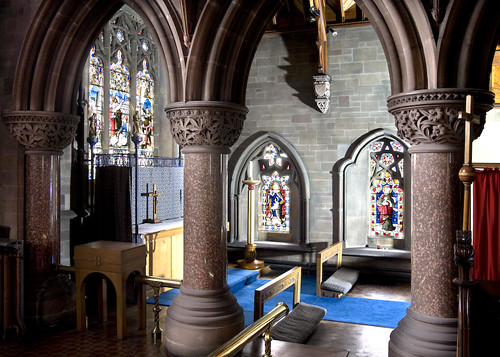
The Royds Chapel, Photograph by Andy Marshall.
The marriage between architecture and Masonic symbolism is not a unique phenomenon. Men who are professional craftsman and Architects often incorporate Masonic symbols in their work. Examples of this type of incorporation can be seen in Wren’s additions to the
Andy felt a pressing need to start making a record of Saint Edmund's and other churches with Masonic symbolism because he fears their architectural treasures may not last much longer. “The churches are being closed because the congregations are dwindling and costs for upkeep are increasing. There is statutory protection (via our listing system) but this cannot protect them from vandalism and deterioration, unfortunately.”, said Andy. To this end, Andy is donating his time to preserve these images for posterity.
I’d like to thank Andy for all his work and dedication to this project. If you’d like to see more of Andy’s works, his web site is www.fotofacade.com. (You’ll have to be Flash enabled to view his main site) On Fotofacade, check out the Archmedia tab. Here you will find links to his custom Google Maps of architectural sites, Podcasts, and a video section.
19 December 2007
A Guide to Masonic Symbolism for the Non-Mason
With this week’s release of National Treasure 2: Book of Secrets and the buzz about Dan Brown’s new book The Solomon Key, discussions on the web will invariably turn their attention to Masonic symbolism. The number of queries relating to: “What does this Masonic symbol mean?” or “What do you think about my theory on where this Masonic symbol derives from?” are already floating my way in an increasing rate.
A conch shell has absolutely nothing to do with Freemasonry. I thought it would be instructive to use a non-Masonic symbol as a reference point to describe how different aspects of symbolism are used. That gives me an easy way out for being able to talk about Masonic symbols without breaking any of my vows. Confused? Read on and hopefully you won’t be.
Conch Shell Basics
The conch shell has long been associated as the symbol for Key West , Florida Key West Key West
The answer to this question is the same for any group that utilizes visual symbols. Virtually every business, government, organized religion, and social group employs some type of visual symbols. The examples are too numerous to list, but a simple look to the conch for a proof of this point.
All of the aforementioned groups employ visual symbols for one reason; to easily convey a set of complex ideas within a pictogram. The basis for utilizing pictograms reaches back to early written language and art. Pictures were employed to convey ideas. A single symbol became associated with a specific idea or object, and viola; a written language is born. Chinese and Sumerian are perfect examples of languages that employ pictograms as a written linguistic device. Modern symbolism has developed from these humble pictogram beginnings.
Most Masonic symbols are of moral lessons in nature. Specific symbols can range in meaning from time management to everyday mortality. Within a Degree, a Mason is told what each symbol means in the context of that Degree. Some symbols have secondary meanings that show up in other Degree work. What is missing from the explanations is a historical context for the use of that symbol. There’s plenty of legend and lore surrounding the stories told in degree work, but it is nearly impossible to pin down historically. This would leave plenty of speculation and detective work left to those who seek the meaning in the symbols and lore. The loose ends also make it very attractive to assign meaning where meaning might not exist.
But isn’t that just what they tell low-level Masons? The “higher-ups” really know what the symbols mean.
The individual interpretation premise is the reason wildly varied and broad interpretations exist for Masonic symbols. One gets a true feel for this admonition when referencing 19th century Masonic authors. The speculations of Waite, Pike, and Gould are often taken as authoritative stances on symbolism and their context within Masonry. Within the framework of each author’s research and beliefs, they assigned their own meanings to Masonic symbols.
The answer is no. Once a Mason has obtained the degree of Master Mason, or the 3rd Degree in the Blue Lodge, he is a full Brother. Anyone that chooses to become a part of the Scottish or York Rite has just decided they want to expand their experiences within Masonry. So this doesn’t mean that I can get a 14th Degree Scottish Rite Mason to do my laundry or wash my car.
Our conch takes his son to his grandfather for clarification of the mysteries of the conch. The grandfather looks at the young lad and says, “Son it’s always been that way. But I think the symbol must be linked to that book Lord of the Flies. They used a conch shell in that book. So someone must have read it, lived in Key West
So what’s the deal with the symbols on the rings and auto emblems?
Many of the symbols you might see on auto emblems, t-shirts, rings, and other Masonic swag are peculiar to a specific Degree. These symbols take elements a Degree’s story and place them in a Cliff’s Notes visual format. This is especially true in the Degree work of the Scottish and York Rites. Each of the Degrees has their own symbols that are unique to the Degree.
Wrapping up the longest article ever.
I hope this has given some of you a glimpse into Masonry and the reasons we employ the symbols we use. This is simply an overview of my perspective on Masonic symbolism. Masonry, in some respects, is like a primer for a multitude of esoteric traditions. Each Mason incorporates this banquet into their lives as they see fit. Just try to remember this when thinking that Nicholas Cage might be on to something by fitting the pieces of the puzzle together.
17 December 2007
The Family Life Church versus the Compasses and Square
The Burning Taper reported this week that the
The fact of the matter is that the building legally belongs to the
What does bother me about their actions is that even if they take issue with Freemasonry, I never believe it’s a good idea to destroy a symbol of the past. That’s their right too. The members of the
18 October 2007
National Treasure 2: Book of Secrets Trailer
There are lots of Scottish Rite images in the trailer, and I'm sure there's also a ton of "hidden" imagery as well. The movie is set to be released on 21 Dec 07, the Winter Solstice.
31 August 2007
Are Strange Things Afoot In Italy?
One of the reasons I started writing this blog was purely selfish. For the last few years, each week, I’d squirrel away articles of interest I would find on One Note. One of my hopes was to be able to discern some patterns in news stories and track new research into the areas I’m interested in. One of the patterns I’ve seen this summer in the “Seeker-esque” news cycles has been events in
The Catholic World News web site had a small blurb about Italian Police investigating 20 separate Masonic Lodges and gathering membership lists from various Lodges around the country. This is the only report I’ve been able to find on this and since there has been no follow-up in the press I’ve seen.
6 June 07: Five Men Are Acquitted in the Roberto Calvi Case
The P2 Masonic Lodge scandal of the early 80’s is brought into the minds of the world again when five men are found not guilty of murdering “God’s Banker” Roberto Calvi. Calvi was found dead in
19 June 07: Italian cops put "obscene" Da Vinci Code movie under the scanner!
Italian state prosecutors put the Da Vinci Code film under the microscope for being obscene from a “religious standpoint”. The complaint stemmed from someone in the unnamed faction of clergy near the Italian
21 June 07: Archaeologist sparks hunt for Holy Grail
Archaeologist Alfredo Barbagallo announces that he has found the Holy Grail in Basilica of San Lorenzo Fuori le Mura in
30 June 07: Pope OKs opening of St. Paul's tomb
Pope Benedict XVI gave the go ahead to place a fiber optic probe into a tomb in that has been “positively identified” by Vatican archeologists as that of
6 July 07: Modern-day ‘tomb raiders’ feel the heat
Italian authorities renew their efforts to stem the tide of illegal archeological digs and an ever increasing black antiquities market. The article goes on to say that there is also a growing problem with antiquities thefts., “Thefts in churches, libraries and state archives have increased in recent years, and the Carabinieri are still seeking more than 2.5 million missing objects registered in the art squad’s database”
18 July 07: Scholars in panic mode over Vatican Library closure
The
27 July 07: New ‘Last Supper’ theory crashes Web sites
Slavisa Pesci, an amateur scholar announces that he has found interesting results in Da Vinci’s Last Supper when applying an overlay mirror image on top of the original. He claims that one of the images unlocked is of a Knight Templar holding a baby. The news crashes a number of websites that have photos of his theory.
10 Aug 07: Priest under investigation apologizes to Jews after insulting remarks
Priest Pierino Gelmini makes the remark in an Italian press interview that the “radical-chic Jewish lobby is stretching out to weaken the whole Church, starting with the
26 Aug 07: Bad Luck for Black Cats in Italy
An animal rights group in
11 August 2007
Catholic Priest Meant to Slander Freemasons, Not Jews
23 June 2007
Midsummer's Eve
This article should be making it's way to Unexplained Mysteries today or tomorrow. But I thought I'd post it here for you all first..
For as long as man has memory, we have ascribed importance to certain days of the year. Be these days’ feasts, astronomical events, birthdays, or anniversaries; a certain day turns into a special event. One has to look no further than their day timer to find multiple examples of how we honor the passage of time in this way. Of all the days in a year, I can think of few that have as much esoteric importance, June 24th.
Masonic lore tells a slightly different tale of the reinforcements that won the day at Bannockburn. It is suggested that Robert the Bruce made a deal with renegade Knights Templar. The Bruce gave any fleeing Templar sanctuary in an excommunicated
Subscribe to:
Posts (Atom)