Key to the Sacred Pattern

27 February 2008

Grail Seekers Media Watch since last time until 1 Mar 08

Grail Seekers this week:

Well since the Grail Seekers web site is up and running now, maybe I can get back to writing more on the blog. It has been much too long…

On Audio:

Congratulations to the Oopa Loopa Café which just celebrated it’s first birthday. Huzzah!

John Hogue discusses the life of Nostradamus, 4 Mar 08, on the Laura Lee Show.

Wednesday 27 Feb 08, Coast to Coast AM will feature Walt Brown on Noah’s Ark.

In the News:

The Ark of the Covenant is showing up in all sorts of places all over Africa, this time it’s in Zimbabwe. The Daily Mail also has an article on Tudor Parfitt’s work.

I missed the Alchemy Fair in Moscow

Cinema Libre Studios has gotten the rights to distribute The Bloodlines Documentary. I hear from a good source that it will be released on May 9th. (Thanks John…)

A white stag is spotted in Scotland, what this means I’m not sure.

The Shroud of Turin is to undergo yet another round of tests.

Has a Druid grave been uncovered in the UK?

The Vatican tries to put a positive spin of the Inquisition by releasing “secret documents”. I wonder if they will sell this set for $10,000 with a bonus Happy Meal.

Blog On:

The Institute for Hermetic Studies blog has announced seminar for those wishing to learn the operative aspects of the Flamel Path of mineral alchemy.

Mark Amaru Pinkham’s Modern Templar blog asks, What’s Really in Rosslyn Chapel?”

The Future Cult blog remote views Thomas Plantard.

The Unam Sanctam Catholicam blog muses that Mount Sinai in Saudi Arabia.

The Templar Globe explains how Candlemas is a Templar celebration.

Anthony North looks at some theories relating to Atlantis.


On Video:

The first volume of The Quest 12 part documentary on the link between the Knights Templar and Freemasonry will be available soon.

26 February 2008

Grailseekers.com is a go!

For those of you who have thought I was slacking off this month, you're right. I have slacked on my duties here at the Grail Seekers blog. However, I have not been drinking Scotch and making potholders. I've been furiously working on the Grail Seekers web site.

I know there are a few tiny issues with the visual end of the site that should be resolved in the next day or so. And there will be more content to come. The site is designed to be an extension of the blog, and vice versa. Hopefully, I will be able to provide everyone with an expanding resource base for your Grail Quest.

So what are you waiting for? Check out the Grail Seekers web site!

18 February 2008

Indiana Jones and the Kingdom of the Crystal Skull Trailer

Looks like this might mix Raiders of the Lost Arkwith Roswell... I guess we'll have to wait until May to find out.

12 February 2008

Grail Seekers Media Watch for the Week Ending 9 Feb 08

Grail Seekers this week:

I’ve been furiously working on the web site for the last few weeks, hence the lack of items on the blog. I’m going to shoot for next Monday publishing of www.grailseekers.com . The site is designed to bring you closer to some of the resources on the web to help your Grail Quest. Keep your eyes on the blog for the announcement of when the site will go live. Now for the news of the last two weeks, and maybe I can get back to doing some blog writing…

On Audio:

The Oopa Loopa Café had a show on archeological trends in 2008 on the 8th.

Laura Lee will interview Timothy Freke and Peter Gandy about Christianity's Gnostic origins on the 15th.

Red Ice Creation’s featured interview is with John Lash on Gnosticism and the Abrahamic religions.

In the News:

There was a meeting of the Knights Templar Croatia and Slovenia took place in Medjugorje during the last week-end of January.

The last episode of the TV series Miriana Coljerò, was filmed in Malta with a Templar battle scene this week.

More news from Iceland on the Grail hunt there. A knife found in 1990 has given the team some hope they are on the right track.

The double life of the Dead Sea Scrolls is traced on the CNRS site

Israeli archaeologist revises reading of ancient seal inscription

A new move to save ancient manuscripts in Timbuktu

A white stag is spotted in the Scottish Highlands.

Scottish Mason’s marks to be recorded (Thanks Bob)

On the Web:

The Thule Society wasn’t up to quite what you thought they were up to…

Blog On:

The Discover the Undiscovered Blog has an article and pictures of the Ethiopian Timket celebrations.

The Templar Globe spends 24 hours in Acre

On Video:

A Walking Tour of Rosicrucian Park


27 January 2008

Grail Seekers Media Watch for the Week Ending 26 Jan 08

Grail Seekers this week:

I think the weather in a majority of the US has stymied the flow of news this week. It’s pretty dead on the wires this week. Work on the web site continues… And I thought I had written a lot of content for the site over the past year… No so much. I’ll keep you posted.

On Audio:

Michael Tsarion is interviewed on the Occult of Personality; Podcast #39 on the Occult History of Judeo–Christianity.

Laura Lee will interview Christopher Knight on 2 Feb 08 about the History of Freemasonry.

In the News:

Are Satanists responsible for stealing Holy Water from the Chiesa della Gran Madre di Dio in Turin? Chalk this up to another odd occurrence in Italy.

It looks like the Bloodlines documentary will finally come out this Spring.

Is Dan Brown’s new novel even close to coming out?

National Geographic begins a nine part on line video presentation called Treasure Wars – Who Owns the Past?


The Biblical Archaeological Society gives some expanded coverage of the Jesus Tomb debates of the last few weeks.

On the Web:

What exactly is the Priory of Sion doing in American politics? I know they’re the ones that talked Fred Thompson to drop out of the race.

A 20 year old picture of odd engravings showed up this week on the Coast to Coast AM web site.

In Print:

The Times On Line reviews a new book that looks at the contributions of Islamic science in the Middle Ages.

Blog On:

The Odd Potato Blog gives us a look into Temket celebrations this year. (They promise pictures are to follow…)

The Templar Globe looks into Templar banking practices and their effect during the Crusades.

Here a Grail, There a Grail: Grail Cups Part 2

Continuing on with the series, Here a Grail There a Grail, we look at five more vessels that are thought by some to be the Holy Grail. Next time, we’ll examine the following vessels: Agrati's Grail, Bruges Grail, Lucca Grail, and the Sacro Catino.

The Chalice bears the name for the Benedictine leader of Saint Denis; Abbot Suger (1122 -1151). The Saint Denis area of Paris has been associated with the burial of French royalty since the time of Dagobert I. A majority of French royalty, including Dagobert I, are buried in the present basilica.

The basilica was the mastermind of Suger himself. He felt in building the basilica that the “use of rare materials gives glory to God”. This was in opposition of Bernard of Clairveau who felt hat churches should has beautiful art work, but the use of gold and precious stones was unnecessary.

The Chalice in the above link is actually one of four Chalices that have survived to present day that Abbot Suger brought to Saint Denis. The other three are now in the Lourve. While Abbot Suger’s Chalice follows the same pattern of an ancient agate bowl in a medieval setting, it is doubtful it is the Grail. There really is no historical pedigree to back up any claims to the contrary.

This Chalice’s home is the National Gallery of Art in Washington DC.

  • Marian Chalice (or the Hawkstone Park Cup)

The tradition of this Cup follows that Mary Magdalene used this Cup to catch a small amount of Jesus’ blood while he hung on the cross. The story goes on to say that Empress Helena found this Cup while excavating Jesus’ tomb in the 4th Century. The Cup was then taken to Rome, but later removed to Britain later in the 4th Century to avoid being pillaged by the Visigoths. This legend was written about by the 5th Century Greek historian Olympiodorus.

In the late 1990’s comes Graham Phillips into the story. He began to track down other Marian Chalice related sources in the UK and came up with a Shropshire family who were descended from the kings of Powys. Phillips evidence was based on a 12th Century manuscript, a 16th Century poem, and a secret code from the 1850’s. Phillips literally tracked down a descendant of the line he was looking for, Victoria Palmer. Ms. Palmer had the Cup tucked away in a corner of her flat, never knowing of its potential significance.

Phillips tells the tale of his Grail quest in his book, The Chalice of Magdalene

This small olive wood bowl has as long a history as any of the other afore mentioned Grail contenders. Legend says this bowl was brought to Glastonbury by Joseph of Arimathea sometime after the death of Jesus. There the Cup was protected by the members of the Church Joseph set up and passed along to congregation there until 1520’s.

Taken from Glastonbury Abby of fear of being looted by Anglicans, the cup ended up in the care of Lord Powell of Nanteos. The Powell family believed that this was the actual Holy Grail and took their stewardship very seriously. After being in their care, the Cup is said to have healed the sick from those who drank water from it. Richard Wagner is reported to have made a trip to Nanteos in 1855 to see the cup while writing Parsifal.

When the last of the Powell family passed away in 1952, the Nanteos House was sold to a Major Mirylees. The Mirylees were somewhat private about the cup. They no longer publicizing the fact they were the owners of the “Holy Grail”. The family did allow a few interviews regarding the cup. One was a 1997 BBC Television documentary and another was an interview granted to the Martinist Review in 1959.

Today, the Mirylees family has placed the Cup in an undisclosed location and has not publicly shown the Cup for a number of years. For more about he Nanteos Cup, I did an article in June of 2006 on the Cup’s history.

  • Patene de Serpentine (or Oxbrow’s Grail)

Earlier this month, the Evening Times announced that historian Mark Oxbrow had, “cracked the mystery of the Holy Grail” Oxbrow theorizes that the Grail is housed in the Louvre Museum in Paris and has been on display there for some time. He believes that the Grail is the Patene de Serpentine, a First Century dish that was used in the coronation of French royalty in the 12th Century. Oxbrow’s book on the subject will hit the shelves in the USA sometime this year.

On 17 August 1995, a press conference was held at the Italian home of Count Rocco Zingaro di San Ferdinando. Zingaro, the Great Precettore of the Order of the Knights Templar in Italy, made the announcement that he was in possession of the Holy Grail. This was in direct response to Graham Phillips announcing that he had found the Marian Chalice earlier that week. According to Zingaro, the Grail was given to him as a wedding present 20 years previous by Antonio Ambrosini. The Grail came into Ambrosini’s possession from a Coptic Monetary in Egypt.

Recent news is that Zingaro intends to return his Grail to “the House of Nazareth” sometime in the near future. In March of 2007, Zingaro is said to have had a vision from the Virgin Mary.

20 January 2008

Grail Seekers Media Watch for the Week Ending 19 Jan 08

Grail Seekers this week:

Happy Blue Apples week to all! I’ve been pretty busy this week working on any number of things. One of the New Year’s resolutions I did make was to finish all the articles I mentioned or started last year. I’ve had some disjointed work on this work on that writing this week as a result. Also, for all of you who have ask for it, a Grail Seekers web site is officially in the works. There will be more to come on this in the following weeks. Stay tuned.

On Audio:

There’s nothing on the audio radar this week, unless you want to call me and I’ll talk to you about the Grail for a little while.

In the News:

A million Indian pilgrims witnessed a miraculous light at Kerala's famed Sabarimala temple.

A Turkish-Hong Kong exploration team believe they have found material evidence that Noah’s Ark is on Mount Ararat

Mona Lisa’s identity has been figured out, yet again.

Biblical experts met this week to discuss the Tomb of Jesus.

Ancient tomb art is found at Tara Hill

The Jesuits have a new leader.

On the Web:

RLC Research and Resource Page has added a video section this week.

Far Shores publishes a good picture of the New Mexico Mystery Stone.

Filip Coppens and André Douzet take on the secrets of the altar at RLC.

In Print:

Real2Can made an announcement about Phillip Gardner’s new book, DVD set Gateways to the Otherworld on a MySpace blog this week.

Blog On:

The Welsh Mysteries Blog considers Wales for the resting place of the Grail.

If the Ark of the Covenant is in Kenya, would it ever be moved back to Israel?

17 January 2008

Here a Grail, There a Grail: Grail Cups Part 1

In reading the headlines over the last year, one would think that finding the Holy Grail was as easy as picking up a shell on a shoreline. It would seem almost trendy to pick a location for the final resting place of the world’s greatest treasure. The fact is that there are more candidates for the Holy Grail out there than one could shake a rather large stick at. This is the first part of a series chronicling some of the different types and traditions of the Grail.

In this first installment of “Here a Grail, There a Grail”, we’ll focus on the Grail as some sort of vessel. This is, by far, the most predominate theory of the nature of the Grail. Most traditions link the Grail as being a vessel used at the Last Supper, although this is not always the case. The following are a description of vessels that hold to being the Grail. This will be the first part of this article. The list was just too long to present in one blog.

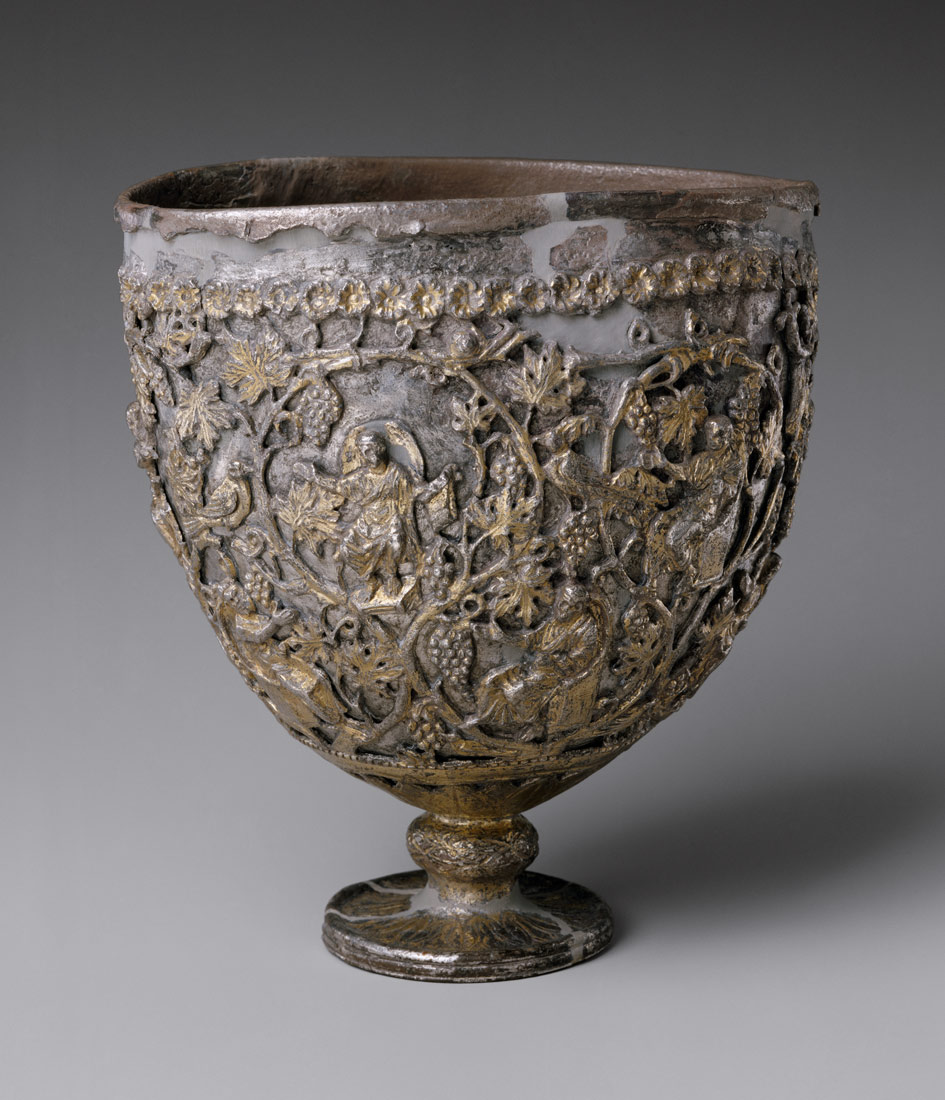
  • Antioch Chalice (Image Link)

This cup was shown at the 1933 Chicago World’s Fair as being the Holy Grail. Found in Antioch in 1910, this relic is actually two cups. The inner, plain silver bowl is thought to be a relic from the Last Supper. The outer more ornate gilded, rinceau-patterned, footed shell bowl is thought to be made in the 6th Century to house the Grail. In 1950, the Antioch Chalice was bought for a rather large undisclosed sum of money from a Syrian art dealer by John D. Rockefeller. The Chalice was then donated to the Cloisters, a branch of the Metropolitan Art Museum, in New York where it resides today.

  • Barbagallo’s Grail

In part of 2007’s strange events in Italy the Telegraph reported that Italian archeologist Alfredo Barbagallo had found the Grail. Barbagallo’s Grail is supposedly buried in a crypt under a terracotta funnel used in funeral rites at the Basilica of San Lorenzo Fuori le Mura. Barbagallo believes that the Grail was entrusted to Saint Lawrence just days before his martyrdom. At this time there has been no indication that the Vatican is willing to let Barbagallo excavate under the Basilica.

  • Glastonbury Dish (or the Chalice Well Cup)

One of the stranger tales of the acquisition of the Holy Grail was presented in early 1900’s England. Pulling elements of mystical visions, Guardians, and holy places; the story exemplifies the quest for the Holy Grail. This cup is rarely mentioned in the mainstream lists of many Grail contenders. However, due to the circumstances surrounding this cup and the persons involved, the tale is fascinating.

This contender’s story begins in the early 1890’s, the father of Welch Doctor John Goodchild traveled to Bordighera, Italy. The elder Goodchild bought the Dish form a local merchant. Upon returning to England, John Goodchild began to have visions that this was actually the Grail. Goodchild’s visions told him he was to return the Dish to Glastonbury. Upon inheriting the Dish in 1898, Goodchild followed his visions to Glastonbury. It’s unclear what Goodchild did with the Dish at that point, however most believe that he hid it around the Chalice Well.

The only person Dr. Goodchild told about his visions and extracurricular activities was William Sharp. Sharp was an author that wrote about Celtic mysticism under the pseudonym of Fiona Macleod in the 1890’s. Supposedly, neither Goodchild nor Sharp ever told anyone of the disposition of the cup.

All would seem top have been forgotten about the Dish. Sharp died in 1905, supposedly taking the location of the cup to his grave. Goodchild also was not speaking of his find. However, mystical visions intervene a second time in this tale. In 1906, a grain merchant from Bristol named Wellesley Tudor Pole had a vision to send a messenger “pure in the sight of God” to search Glastonbury’s well for the Grail. Giving the directions to his daughter and a friend, they set out to examine the Well. After the friend and daughter’s confirmation of the directions in Pole’s vision, Pole set out to find the cup. It was shortly there after Pole did find Goodchild’s cup.

The Glastonbury Dish was quite the rage in England after Pole’s find. Pole made the social circle rounds touting the Dish and his story of its discovery. It was even shown to Mark Twain during his 1907 trip to England. Twain was so taken by the experience that he was quoted as saying by his biographer Albert Bigelow Paine: “I am glad I have lived to see that half-hour—that astonishing half-hour. In its way it stands alone in my life’s experience.”

  • Occitan Grail

More folklore from Languedoc than an actual object, the Occitan Grail is thought to be a wooden bowl made by Adam. Yes, that’s Adam as in the first man Adam. He passed this cup down through his lineage all the way to Jesus, who used it in the Last Supper. From there, Joseph of Arimathea and Mary Magdalene took the Grail to the South of France. The Grail then disappears off the radar only to reappear in a traditional story.

This is possibly one of the most identifiable cups that has laid claim to the Holy Grail. Pope John Paul II even celebrated Mass with this Chalice in 1992, but left short of indicating it was the Grail. Pope Benedict XVI also stopped over in Valencia in 2006 to venerate the Chalice.

Tradition around this Chalice says that Saint Peter brought it from Jerusalem to Rome. The Chalice was said to have been used in Masses there for two and a half centuries. During the 250’s persecution of Christians in Rome, Pope Sixtus II gave the Chalice to Saint Lawrence for safe keeping. Lawrence then took the Chalice to his home city of Huesca, Spain. The Chalice was taken from city to city in Spain, avoiding various Moorish invasions until 1437. At this time it was taken to the Cathedral in Valencia and has resided there ever since.

When looking at the pictures of the Chalice, one has to remember that it is actually two stone bowls in a gold mounting. The bowls have been dated by Antonio Beltran, professor of archaeology at the University of Zaragoza as being made sometime between 200 BC and 100AD. The golden piece that connects both bowls was dated by the same source as 14th Century.

15 January 2008

Grail Seekers Media Watch for the Week Ending 12 Jan 08

Grail Seekers this week:

Sorry for the late update this week. Working nine days straight will but the smack down on ye olde muse. I’m off today and I’ve fired up the coffee pot and the MP3 player, so watch out!

On Audio:

Templar fiction author Steven Berry’s interview has been posted on Radio Rennessence.

Robert Lomas will be on the Laura Lee show on 23 Jan 08 talking about Tesla.

Oopa Loopa Cafe will have an interview with John Anthony West on erosion patterns in the wall of the Sphinx's enclosure on 17 Jan 08.

In the News:

Da Vinci must have worked overtime to have hidden everything in his paintings that have come out in the last year. Now a Gloucester Mason has found a few more.

Martha Byrnes examines Templar banking practices and what happened in the wake of the events of 1307

Want to find archeological treasures from the comfort of your home? It’s not too far fetched as NASA satellites and Google Earth are used to do just that.

Photographers come out against the ban on snapping pics at Rosslyn Chapel.

A treasure trove of Islamic writings surfaces after 60 years of suppression.

If you’re an architect and would like to help with the conservation efforts at Rosslyn Chapel, click here. What a dream job that would be…

On the Web:

The Skeptical Inquirer takes a poke into Oak Island and Rennes-le-Chateau

In Print:

Ouroboros Press announced its Spring publishing line up on a My Space Blog this week.

Remember the guys that were walking from France to Jerusalem? They’ve written a book about their experiences that is called Along the Templar Trail and is available now.

Author Tracy Twyman is auctioning away a signed copy of The Merovingian Mythos and the Mystery Of Rennes-le-Chateau

Blog On:

Maxine’s Fikr page has some of pictures of Rosslyn Chapel right after Christmas. And the little barrier behind the Apprentice Pillar has been taken down…

The new blog Mary Magdalene – The Wife of Christ talks about the Rose Line of Mary Magdalene

10 January 2008

Iceland: The Land of Björk and the Holy Grail?

The location of the Holy Grail has made yet another appearance in the main stream media. Grail Seekers everywhere are now directed to the land of geothermal power, Björk, glaciers, and The Sugarcubes; Iceland. The publication Iceland Review published the theory of architect Thórarinn Thórarinsson and Italian cartographer Giancarlo Gianazza on 2 Jan 08.

The pair believes the final depository of the Grail is in a five meter secret passage in the rural district Hrunamannahreppur (try saying that five times real fast, or finding it on Goggle Earth for that matter). The area in question is near the Kjölur Mountain pass in a place that Gianazza calls the seats of White Rose of the Blessed and Beatrice. Thórarinsson has also secured the necessary approval from the Hrunamannahreppurian authorities to conduct digs in the area to validate their claims.

The Iceland Review article doesn’t go into much detail on how the duo came to believe the Grail lay in Iceland. Luckily, I was turned on to this story with another source via Rick at Oopa Loopa Cafe and have had a couple of weeks to stew on it. Giancarlo Gianazza was interviewed in the Italian publication Hera Magazine in November of 2006, and an English translation is found on gopfrettir.net.

In the article Gianazza goes into great detail on how they were able to pinpoint the location of the Grail using art and literary references. Botticelli, Da Vinci, and Dante are all indicted as co-conspirators in encoding the location of the Grail in their works. The Botticelli and Da Vinci connections and evidence is a little tenuous. Gianazza points out the same vague hidden geometry that we’ve seen since the Tomb of God was published.

Call me dumber than a sack of hammers, but I’ve never seen the significance of the points that most theorists chose to find their hidden geometry/meaning in paintings. Or for that matter why some elements of a painting have significance while others do not. Gianazza points out in Botticelli’s painting Spring, that five of the nine figures encode a date. What significance do the other figures have? One would think that all the elements would hold significance. Maybe art just isn’t my thing…

The lynch pin of their theory is that the Divine Comedy was written as an allegorical to a trip Dante made to Iceland. This I can wrap my mind around. According to Gianazza specific verses in the Divine Comedy make veiled references to his trip and have encoded longitude and latitude points. All this taken together pointed Gianazza to his specific spot in Iceland.

That’s not quite all. The most promising gem of the whole theory is buried at the bottom of the article. Gianazza states: “He [Thórarinn Thórarinsson] has told me that in the official historic records of Iceland it is stated that in 1217, during the meeting of the Althing – the Parliament established in 930 – the leader and poet Snorri Sturlusson appears next to what the text defines “80 knights from the south, all dressed and armed in the same fashion” and is elected as commander for that year.” Of course the inference is that the 80 knights mentioned are the Knights Templar.

I know there’s half a dozen possibilities of who those Knights were. But, there’s no reason that the Templars wouldn’t have shown up in Iceland in 1217. By that time, they were well into shipping and had their fingers in every Royal Court in Europe. Iceland would have been a prime place to keep a stash hidden out of the sight of prying eyes.

Finally, Gianazza has conducted georadar and electric tomography measurements of the area he’s pinpointed. According to the scan pictured in the Hera article, there does seem to be some mass below the surface. I guess sometimes it doesn’t matter how you get there, as long as you do. Since the blessings of the Icelandic authorities have been given to dig, there could be news very soon on what actually lies beneath the lichen.

08 January 2008

The Debate over the Rosslyn Motet Heats Up

Over the last few weeks, there’s been an interesting exchange happening in the comments section of BS Historian’s article "Rosslyn Chapel’s Musical Cubes Silenced?" For those of you not familiar with the article or the comment thread, there are some serious questions about Stuart Mitchell’s Rosslyn Motet by BS Historian and Jeff Nisbet. The basis of the detractors from the Motet is that an 1860’s restoration team replaced a great number of cubes in Rosslyn Chapel. This theory is supported by lithographs done in 1837 by Samuel Dukinfield Swarbreck. In these lithographs, Swarbreck depicts a great number of missing cubes from the ceiling at Rosslyn.
This would mean that the basic theory behind the Rosslyn Motet is not accurate. The Mitchell’s theory behind the Motet is that the Sinclair family encoded the cubes with Chladni patterns to conceal a piece of music. What happens to the basic premise if cubes were added in the at a later date?
This isn’t the first time Mitchell’s work has been brought into question. A number of folks, myself included, have come out and expressed their doubts about the Motet. Here’s a run down of articles that present alternate view points on the matter:
  • Jeff Nisbet’s article The Rosslyn Motet expressed issues with the history of the Cubes, in relation to the Motet, and inconsistencies in the news stories related to the Mitchells.
  • Researcher and writer for the Fortean Times, Brian Allen ask me to post an open letter that questions whether the Sinclairs would have had access to technology that would have allowed them to have discovered a Chladni pattern, let alone encode the cubes with them.
It would seem that Stuart Mitchell has responded to some of BS Historian and Jeff Nisbet’s arguments in the comments section of Rosslyn Chapel’s musical cubes silenced? Mitchell’s comments are comments 11,12, and 15. It would seem that, other than the use of the incomprehensible phrase Mr. Muskateerwang, Mitchell doesn’t give an answer to the central question.
Mitchell’s comments on the 1860’s restoration and the Swarbreck lithos are, “You say the cubes have been ‘re-arranged’? And are not in the order first presented in 1446 and your evidenced,(taken from Lithographs which are artworks and artistic interpretations) is this?? WHO WOULD RE-ARRANGE THEM???? This chapel had a BLUEPRINT, look at the design, detail and infrastructure. There was a plan and any restoration would naturally stick to the original…WHO would NOT STICK TO the original designers intentions??”

Wouldn’t this mean that the 1860’s restoration team would be privy to the Sinclair’s original design and intent? That would mean that there was someone out there that, at least up to 1860, knew the keys to unlock the architectural and design secrets of the Chapel. If that’s the case, I’d love to see a write-up on how that came about and who was in the "know".


Now there would be another interesting twist to debate over the Motet. Jeff Nisbet posted on 6 Jan 08, as comment 20 in the thread, that all the cubes in the Swarbreck lithos appear to be the same. So there might not be any mystery attached to the cubes at all. If the original design of the cubes was identical, there could be nothing coded in the cubes by the original architects of the Chapel.
I would urge you to read the threads and articles posted above in full and form your own opinion. Jeff and Historian have brought up a number of points that need to be answered if the world is to accept the Motet as the final answer to the Rosslyn Cubes.

31 December 2007

Grail Seekers Media Watch ending 31 Dec 07

Grail Seekers this week:

I thought I’d hold off on doing the news until today this week. It seems appropriate to wrap up the year this way. Once again I’d like to thank everyone out there that has been so supportive of my work this year. I can only hope that next year is as interesting and productive as 2007 was.

I ask my wife yesterday what her New Year’s resolutions were. She, rather curtly, informed me that she did not believe in them. How could I have missed that small fact in the years we had been together? Obviously, I don’t listen as well as I should. So guess what my resolution is this year…

Don’t forget to eat your black-eyed peas, cabbage, hog jowl, and any other food that mystically will bring you good luck for the New Year. Myself, I’m going to warm up some haggis and wish I was in Edinburgh for Hogmanay.

On Audio:

Steven Mehler will talk about the waterways beneath Giza's Pyramids on 1 Jan 08 on the Laura Lee show.

Don’t forget to check out the Oopa Loopa Café interview with Michael Cremo which aired on the 27th.

In the News:

The Royston Caves are in trouble of being damaged by truck traffic. Thanks to My Space friend Crint Eastwood for the heads up on this article.

The Kebra Negast is now available in French. Then again if you’re reading this blog you can read English and wouldn’t need a French version would you?

The “Temple” in London starts a four month celebration of the area’s history.

What exactly was the Star of Bethlehem?

Do these standing stones in the UK align with Orion’s Belt?

On the Web:

The Key of Solomon web site explores the temple and seal of the wisest man in the world.

Blog On:

Speculations about Archbishop Michael Lefebvre and the Priory of Zion just simply won’t die.

28 December 2007

The Holy Grail Has Been Found, Again…

The news hit the streets yesterday, via the Evening Times, that historian and author Mark Oxbrow has put his hat in the ring for discovering the location of the Holy Grail. This marks the third time this year that the Grail has been found. The first was in June when Italian archeologist Alfredo Barbagallo announced that the Grail was in Basilica of San Lorenzo Fuori le Mura in Rome. Another location of the elusive Grail came from Ferhat Kanarya. He pinpointed the Grail’s resting place in the Hagia Sophia.

It would seem that Oxbrow has confirmed that Dan Brown was partially right, the Grail is in the Louvre. However, it does not rest under I.M. Pei’s pyramid. Oxbrow theorizes that the Grail has been on display in the Louvre for years, and no one has noticed it. That was until he and his wife visited the Paris museum.

Oxbrow’s Grail is actually the Patene de Serpentine, a jewel encrusted dish dating back in the 100BC to 100 AD range. The dish was used in Saint-Denis during the 15th century when the abbey was used for coronations of French royalty. Oxbrow feels that the use of the dish was the inspiration for Chretien de Troyes early literature about the Grail. "It's impossible to prove 100% that the Patene de Serpentine is the real Holy Grail.

But the Patene is a sacred medieval treasure that perfectly matches every detail of the earliest descriptions of the Grail.” said Oxbrow in the Evening Times article.

For years, Oxbrow has been doing research into the Grail world. In Rosslyn and the Grail , Oxbrow sought to set the record straight about Grail theory and the famous Scottish Chapel. The text takes Grail theorists Andrew Sinclair, Tim Wallace-Murphy, Knight and Lomas, and Baigent and Leigh to task about their claims about the Chapel. I’m curious how Oxbrow’s theory will fair under the same scrutiny he has put the other theorists to.

25 December 2007

Happy Holidays from the Grail Seekers Team


I'd like to thank everyone out there that has shown support for this blog over the last year. All the e-mails and contact I've gotten from you have really made the difference some days between me writing another article and packing it all in. Thank you all so very much for helping me along my own Grail Quest. Have a happy holidays!
Brian

23 December 2007

Grail Seekers Media Watch for the Week Ending 22 Dec 07

Grail Seekers this week:

Have a holly, jolly Christmas everyone. I hope Santa brings you all the goodies that your heart desires. I myself ask for a winning lottery ticket, but somehow I don’t think I’ve been that good this year. And please, don’t forget to go out and do something for your fellow man. Even if it’s just a random gesture of goodwill, do something. It’s not that hard to make a small difference in someone’s life.

On Audio:

Radio Rennessence is now presenting their year end RLC extravaganza. According to an e-mail I got from Corjan the special is: “Over an hour of hot debate of Andrew Gough, Philip Coppens, Corjan de Raaf (and his flu) giving an awful lot of details and background information you won't hear anywhere else.”

In the News:

Rosslyn Chapel bans photography in 2008.

On the Web:

Ray H Marr has done a video series on the history of the Knights of St. John. Thanks to Red Ice Creations for posting all the parts of the video in one place.

Blog On:

The Realtravel blog has a travel-log of a visit to Aksum

Codex Celtica takes a look back at this year in esoteric terms.

The La Bas blog asks if there’s a link between French Surrealism and Secret Societies

Futurecult takes a tongue and cheek investigation into the Priory of Sion in Springfield Missouri

EVS-Islands does an Enhanced Vector Shoreline study of Tana Island in Ethiopia

The Illumanati Conspiracy Journal wonders why Jacob Rothschild married into the Sinclair family.

20 December 2007

Rosslyn Chapel to Ban Photography

According to a Scotsman article Tuesday, the officials at Rosslyn Chapel are banning all types of photography inside the Chapel beginning 2 Jan 08. According to the article: “Colin Glynne-Percy, the director of the Rosslyn Chapel Trust, said: "I would hope that people come to see the chapel, not just to video it, so I would expect visitor numbers to be unchanged. The problem is one we have had for quite a while, because the chapel is quite dimly lit and there are cracked and uneven slabs.”

Huh? The problem with this explanation is that visitors will be at the same risk of tipping while looking at the ceiling, or photographing it. While there are areas of the Chapel that has, what I would consider, uneven slabs. Around the Apprentice Pillar, there is a small step up behind pillar. You’d have to be a pretty big klutz to trip over this small step up.

I would think the scaffoldings around the outside of the Chapel would be more of a safety concern. The steps up to the top of the scaffolding are quite steep and can get slick when it rains. There has to be a greater risk of someone falling off this while taking pictures that stubbing their toe on something inside the Chapel.

The Apprentice Pillar at Rosslyn Chapel taken on 15 Oct 07
with a cordoned off area behind the Pillar.

The article goes on to say, “"In the past we have used tape to cordon off some of the worst areas…” When Laura and I were there in October, there was a cordoned off section right behind the Apprentice Pillar. The section had yellow and black caution tape around a piece of plywood behind the Pillar. When I ask the on site tour guide about the area, she had told me “Repairs or some such work going on over there.” After going back through photos other visitors had posted on line, I was able to ascertain that the section was corroded off sometime between 22 Sept and 3 Oct 07. I have not seen any photos of the area dated any later than mine on line, so it still could be there.

This area is also the perfect spot for conducting any type of unobtrusive studies of the Pillar. One could dig down, bore a hole from underneath the Pillar, and insert a file optic camera into the Pillar itself. No one would be with wiser. This would be a rather easy way to put the speculation to rest that he Pillar was hollow and contained that magical treasure everyone is looking for at Rosslyn.

Speculation that the Pillar is hollow generally relates back to a Masonic legend. The story is that before the Flood, Enoch placed a book containing all the antediluvian arts and sciences, and laws of the universe either beneath or inside two pillars. Some have tried to make the connection that this story is a veiled allegory to what is hidden at Rosslyn.

Somehow I think there is more going on at the Chapel than just a concern for safety. Signs posted that said, “Uneven steps proceed at your own risk.” would pretty much release the Chapel of any liability in a lawsuit. So what’s the real motive behind the photography ban? You and I may never know.

19 December 2007

National Treasure 2: Book of Secrets Review

The allure of a seeing something on the silver screen is that you are mystically transported out of your everyday life. Reality is suspended and any numbers of worlds open up that are impossible to obtain for those munching on popcorn in the aisles. Our inner Indiana Jones is called to in National Treasure 2: Book of Secrets. Nicholas Cage reprises his role as Benjamin Franklin Gates, finder of the lost Masonic/Templar treasure in the first film.

The hook this time is a little known group called the Knights of the Golden Circle (KGC). The KCG was a very real group of Southern sympathizers that operated as somewhat of a guerilla force during, and after, the Civil War. Modern day treasure hunters have long thought that the KGC horded gold and goods in secret locations throughout the country waiting until the time was right for the South to rise again.

The movie’s treasure trail begins with John Wilkes Booth and another member of the Knights of the Golden Circle (KGC) seeking the aid of Cage’s great-great-great grandfather Thomas Gates. Members of the KGC have planned the assignation of Lincoln and are hunting for a treasure that will fund a second Civil War. Gates is sucked into their plot by being asked to decrypt a cipher contained in John Wilkes Booth’s diary.

Granddaddy Gates cracks the code and realizes that he’s been duped by the seditious KGC members. Gates burns the relevant pages of Booth’s diary and is shot by a KGC agent for his trouble. Flash forward 140 years and bad guy Ed Harris presents a fragment of the diary to the world, naming the Gates family as the masterminds behind the Lincoln assignation. Feeling the only way to clear the family name, Cage and father Jon Voight is to find the treasure the KGC was looking for. After that the usual globe trotting, treasure hunting high jinx ensue.

National Treasure 2 follows the same formula of car chases, techomancy, and 30 second solutions to hidden history as its predecessor. The film is an easy on the mind, romp into finding lost loot. That’s my biggest problem with the whole endeavor, that it’s easy on the mind. I understand that the key to commercial success is to make a movie accessible to everyone. However, the script writers had a golden opportunity to plant Easter eggs for those historically minded folks out there.

There was a half hearted attempt to do so. The references to Albert Pike, the missing pages of Booth’s diary, and the fictional President’s book of Secrets did give me hope there would be more to sink my teeth into. But when dealing with a film that literally has our hero pull a lever and the entrance to the treasure appears, one gives up hope for any additional complexity. The biggest mystery left to ponder in the film is what’s on page 47 of the President’s Book of Secrets. Oh wait, I know… It’s the hook for National Treasure 3. I guess it is possible to solve some mysteries in less than 30 seconds.

There’s no real reason to pay for this instead of waiting to download it on Amazon Unboxed. That is unless you have nothing better to do this weekend and wish to be inspired to hunt for long lost gold…

A Guide to Masonic Symbolism for the Non-Mason

With this week’s release of National Treasure 2: Book of Secrets and the buzz about Dan Brown’s new book The Solomon Key, discussions on the web will invariably turn their attention to Masonic symbolism. The number of queries relating to: “What does this Masonic symbol mean?” or “What do you think about my theory on where this Masonic symbol derives from?” are already floating my way in an increasing rate.
The topic will stimulate some to do good hard core research into the topic. Others will take flights of fancy and ascribe any number of attributes to the symbols of the Craft. I thought I might head off some of the wild speculations at the pass with a guide to what symbols used in Masonry mean to this Mason. This should help those who have an interest in the topic pick their way around a rather complex subject.

I understand that all of you out there that are detractors of Masonry will rail against what I have to say here. That’s your right.  Please don’t fill my inbox with the usual litany I get when I write an article on my experiences in Masonry. I keep an open mind, but please don’t begin your rail with accusations of being in league with the Devil or tales of goats…

Before we start, what does the Conch Shell have to do with Freemasonry?
A conch shell has absolutely nothing to do with Freemasonry. I thought it would be instructive to use a non-Masonic symbol as a reference point to describe how different aspects of symbolism are used. That gives me an easy way out for being able to talk about Masonic symbols without breaking any of my vows. Confused? Read on and hopefully you won’t be.


Conch Shell Basics
The conch shell has long been associated as the symbol for Key West, Florida. It is unclear when the conch shell was adopted for this purpose, but the conch symbolism is firmly engrained in Key West society. A native might refer to themselves as conchs and the conch even used on the “Key West flag”. It is thought that the legend of the Conch was the background for this symbol of the island, but the exact.  Now back to our regularly scheduled article.

Why Does Freemasonry Use Symbols?
The answer to this question is the same for any group that utilizes visual symbols. Virtually every business, government, organized religion, and social group employs some type of visual symbols. The examples are too numerous to list, but a simple look to the conch for a proof of this point.


All of the aforementioned groups employ visual symbols for one reason; to easily convey a set of complex ideas within a pictogram. The basis for utilizing pictograms reaches back to early written language and art. Pictures were employed to convey ideas. A single symbol became associated with a specific idea or object, and viola; a written language is born.  Chinese and Sumerian are perfect examples of languages that employ pictograms as a written linguistic device. Modern symbolism has developed from these humble pictogram beginnings.

Freemasonry is no different than these pictogram languages. The symbols of the Craft are designed to impart a moral or esoteric meaning. Visual representations of symbols in the first three degrees of Masonry are generally objects that someone, of years gone by, would commonly see. A beehive, an hourglass, a rough cut stone (or ashlar) would be real world anchors that would remind the Mason of their symbolic lesson.

Take our conch shell as an example. A native of Key West is walking on the beach and sees a conch shell lying on the beach. His first thoughts of themselves as a "conch" might very well come to mind first. Their thoughts might then range to their neighbor conchs and the warm fuzzy feeling it gives them to be part of that group. The natural extension of the thought goes to he should be a good neighbor to his fellow conchs.

The same holds true for a Mason when he views any of the symbols he has been exposed to. The symbol reminds a Mason that he should be industrious or kind or benevolent. In this way we are reminded of the many moral obligations we have when living a very real-world life.

So what are you told that symbols mean when you’re a Mason?
Most Masonic symbols are of moral lessons in nature. Specific symbols can range in meaning from time management to everyday mortality. Within a Degree, a Mason is told what each symbol means in the context of that Degree. Some symbols have secondary meanings that show up in other Degree work.  What is missing from the explanations is a historical context for the use of that symbol. There’s plenty of legend and lore surrounding the stories told in degree work, but it is nearly impossible to pin down historically. This would leave plenty of speculation and detective work left to those who seek the meaning in the symbols and lore. The loose ends also make it very attractive to assign meaning where meaning might not exist.

With this in mind, it’s rather hard to think of Masonic symbols being used in any type of “coded” way by Masonry as a whole. I tend to be suspect of anyone who starts out their theories with this mind set. Let’s take a building that has incorporated Masonic symbols into its architecture. An author is making a case that “the Masons” incorporated these symbols into the architecture of the building for an esoteric purpose. I would suggest in cases like this, look at the individual that was responsible for the building’s architecture first. More than likely it was this individual’s motives and esoteric thought that created the building, not the entire fraternity of Masons.

Now, our Key Westerner who is feeling warm and fuzzy after the previous section.  He now considering how best to explain what it means to be a conch to his son. After thinking about all the different aspects of the conch, he can’t come up with a simple explanation. Our Key Westerner is now stymied at how to explain how the conch became to mean all of these things to his 6 year old. The best explanation he can muster is that, “The conch’s meaning been passed along for generations and now I’m telling you what it means.” 


But isn’t that just what they tell low-level Masons? The “higher-ups” really know what the symbols mean.
This statement is a common misconception most hold about the use of Masonic symbolism.  It is true that many of Masonry's symbols can have different applications.  However, all Masons are admonished to find additional meanings to symbols presented in the Degrees in their own way. The funny part is that after I achieved the 32nd Degree, I had more questions than answers about the symbols that had been presented to me.  Masonry follows in the vein of all esoteric educational systems. The onus of application and interpretation of anything that is presented in a Degree is one's own.  The symbols of Masonry become peculiar to each and every Mason.


The individual interpretation premise is the reason wildly varied and broad interpretations exist for Masonic symbols. One gets a true feel for this admonition when referencing 19th century Masonic authors. The speculations of Waite, Pike, and Gould are often taken as authoritative stances on symbolism and their  context within Masonry. Within the framework of each author’s research and beliefs, they assigned their own meanings to Masonic symbols.

The fallacy that many make is that Masonic authors, especially Pike, are a single authoritative representative of Freemasonry. These authors are no more a voice for all of Masonry than I am. Yes, there are men who take on leadership positions in Masonry who do speak for groups of us. These men in leadership positions speak for the group in the same way our elected government representatives speak for their constituents. Sometimes we agree with our representatives, and sometimes we don’t. At the end of the day the legislator is no more, or less, a citizen than fellow that elected him. That means that any Master Mason stands on equal footing with Albert Pike and speaks with equal authority.

This relates back to another common misconception about Masonry. The thought that someone who has done degree work in either the Scottish or York Rites is a “higher up”. I have obtained the 32nd Degree in the Scottish Rite. Does this mean that other Masons who have not gone through the Scottish Rite are somehow less in the eyes of the fraternity than I am?


The answer is no. Once a Mason has obtained the degree of Master Mason, or the 3rd Degree in the Blue Lodge, he is a full Brother. Anyone that chooses to become a part of the Scottish or York Rite has just decided they want to expand their experiences within Masonry. So this doesn’t mean that I can get a 14th Degree Scottish Rite Mason to do my laundry or wash my car.


Our conch takes his son to his grandfather for clarification of the mysteries of the conch. The grandfather looks at the young lad and says, “Son it’s always been that way. But I think the symbol must be linked to that book Lord of the Flies. They used a conch shell in that book. So someone must have read it, lived in Key West and started calling us Westies conchs.” Father and son then go back home thinking the grandfather is a crazy old coot.


So what’s the deal with the symbols on the rings and auto emblems?
Many of the symbols you might see on auto emblems, t-shirts, rings, and other Masonic swag are peculiar to a specific Degree. These symbols take elements a Degree’s story and place them in a Cliff’s Notes visual format. This is especially true in the Degree work of the Scottish and York Rites. Each of the Degrees has their own symbols that are unique to the Degree.

These symbols do incorporate symbols from various esoteric traditions depicted in the Degree. This is an extension of the application of using commonly items and attaching symbolic meaning to them. When a Mason sees a symbol for a specific Degree, it is designed to remind him of the lessons that were taught in that degree. No more, no less.

Getting in their car, our Westie and son decide to go back home. Our favorite conch remembers he has a bumper sticker he hasn’t placed on his car. The sticker is simply the flag of Key West. The father turns to the son and says,” I guess the biggest lesson of the conch is that we should be glad we live in Key West and not Cleveland.”


Wrapping up the longest article ever.
I hope this has given some of you a glimpse into Masonry and the reasons we employ the symbols we use. This is simply an overview of my perspective on Masonic symbolism. Masonry, in some respects, is like a primer for a multitude of esoteric traditions. Each Mason incorporates this banquet into their lives as they see fit. Just try to remember this when thinking that Nicholas Cage might be on to something by fitting the pieces of the puzzle together.

17 December 2007

The Family Life Church versus the Compasses and Square

The Burning Taper reported this week that the Family Life Church in Eglin, IL destroyed a Masonic compasses and square and the cornerstone of a former Masonic Temple the group recently purchased. I must admit that upon hearing the news I was more than a little miffed. Thought of: “How could they?”, “What were they thinking?”,” What do they hate Freemasons so much as to destroy a compasses and square?”, all flooded thought my mind.

I decided that I was in the same trap I rail against at times. Emotion was taking the place of rational thought. A good night’s sleep and a cup of coffee the next morning generally will cure my ruffled feathers. True to form, the day break and caffeine gave me some perspective on the events in Illinois.

The fact of the matter is that the building legally belongs to the Family Life Church. As much as I shutter at the fact the organization would deface a historic building and smash a Masonic Symbol, it is their right to do so. Just as I have the right to set up a pink elephant in my back yard with garden gnomes dancing around it; they have the right to dispose of their property to their satisfaction.

A better solution would have been to have given a local Lodge or the Grand Lodge of Illinois the chance to recover the cornerstone and compasses and square. This solution could have benefited both parties. However, it is obvious that the Family Life Church’s beliefs hold something against Freemasonry. (I’ve attempted to log on to their web site this weekend to view their statements of faith and it’s either down or non-responsive.) The Church’s actions must have been purely symbolic, for whatever motive they have.

What does bother me about their actions is that even if they take issue with Freemasonry, I never believe it’s a good idea to destroy a symbol of the past. That’s their right too. The members of the Family Life Church have every right in the world to believe what they wish. If they choose to believe that the tenants of Freemasonry are opposed to their faith, I’m fine with that.

The question is how wise is it to destroy any symbol on a building that has a historical significance? I would never consider tearing down Auschwitz or an American Civil War Confederate monument. It is not because I hold the tenants of either group in esteem. Quite the contrary, I feel that these symbols should remind us of the atrocities and folly committed by those that have gone before us. These things should never be too far out of sight, or we will never be reminded of the guideposts our ancestors placed for us.

I know there are those that say that the sight of symbols that fall into this category are offensive. I would agree. There is nothing more offensive that thinking about the horrors heaped on Jews in Austria by the Nazis or how seceding from the Union almost cost this country it’s identity. The goal of these places should be to offend. I would rather these places be so offensive to those who look at them, that simply thinking of theminsures their history is never repeated.

The worst I can fault the Family Life Church for destroying something I feel is of architectural and historical import. While I don’t agree with their actions, it was their right to do so. What does it really matter if there is one less compasses and square in the world? As a Mason, the lessons of the symbols are more important to me than any of their physical representations.